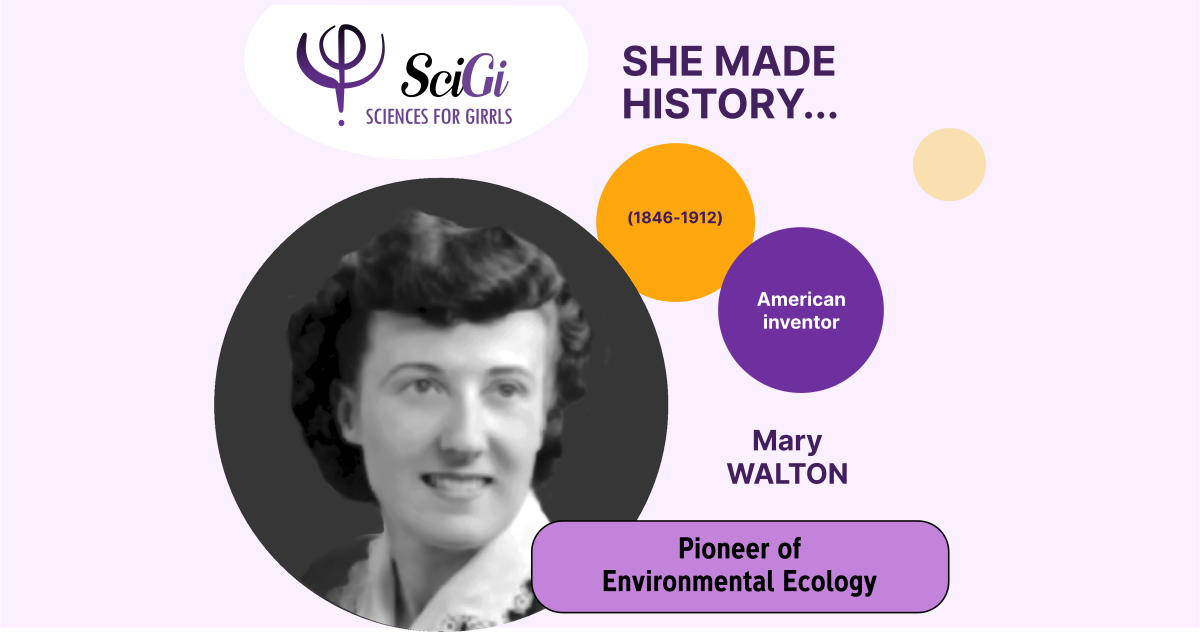

We know almost nothing about Mary Walton’s youth and education, except for a statement made in 1884:
“My father had no sons and believed in educating his daughters. He spared no effort or expense to that end”. Mary WALTON, 1884
However, there is no record of her receiving a formal education. But as we will see, she was later hailed by the Woman’s Journal as a woman who succeeded where “the most famous inventors of the century had looked into the subject without being able to provide a solution”
So, what subjects did Mary Walton apply her brilliant mind to?
To very concrete problems of her time. Indeed, as the owner of a boarding house in New York, right next to the city’s new Gilbert elevated railway, she was bothered by the noise, or rather the constant roar of steam engines, the sound of screeching brakes, the vibrations that shook adjacent buildings, and the smoke that “escaped, leaving a layer of soot on all surfaces. So, she set out to reinvent the railway technology of the” time and succeeded where Thomas Edison himself had failed.
Context

Let’s revisit the context of the time. The American Industrial Revolution attracted middle-class workers from rural farms to factory jobs that were springing up at a dizzying pace in cities like New York, where they were quickly joined by millions of European immigrants seeking a new life. All these people were transported in New York by a new system of elevated trains, or ‘els’, which resonated, blew, and spewed smoke along nine miles of track that ran along most of the city’s main arteries.
The songs and chants that had long marked the rhythm of manual labor were soon drowned out by the incessant tinkling and humming of cutting-edge machines powering urban factories. And the air New Yorkers breathed was polluted by these machines, and by many other sources of pollution: oil and kerosene refineries, varnish and fertilizer factories, ammonia plants,… which sent thick smoke over the city.
Inventions
A pioneer in factory pollution control, Walton developed, as early as 1879, a method to direct the smoke emitted by locomotive chimneys (but also applicable to industrial and residential chimneys) into water tanks, where pollutants were retained and evacuated “into sewers, or into other appropriate channels to lead them to a distant or desired locality”. This water tank system redirected smoke, odors, and pollutants away from the city and out of the air. The method is listed under U.S. Patent #221,880.
Traveling to England to promote her invention, British officials hailed her device as “one of the greatest inventions of the age”. Perhaps not surprising, given Charles Dickens’ 1852 description of London fogs and “streets full of dense brown smoke”.

Now to tackle noise pollution: The elevated trains created an intolerable amount of clattering and ringing and significantly disrupted daily life. It “was so disruptive that people couldn’t bear to live near the tracks. The city of New York even called on America’s most famous inventors, including Thomas Edison, to find a solution. However, it wasn’t Thomas Edison, who worked on it for 6 months, who could solve the problem. It was Mary Walton, and her approach deserves to” be known.
She begins by traversing the city’s elevated rails for three days, hiding on the rear platform to listen and observe, her head tilted toward the tracks. After these three days, Walton discovers that the rails amplify the train noise due to the simple wooden cross-supports. She then embarks on creating a miniature railway prototype in her basement. She experiments with different noise reduction systems and develops a soundproofing device consisting of a wooden box, painted with tar to withstand weather, lined with cotton and filled with sand to absorb vibrations, thus reducing noise. Her idea of using sand was inspired by the use of sand to muffle the noise of anvils near her home.
A full-scale version of Walton’s device is then constructed; after a series of trials, Walton obtains U.S. Patent No. 327,422 on February 8, 1881.

When patenting her railway idea, her son recommends doing it in his name (his own), to avoid being seen as a “strong-minded woman”. The mother’s response is delightful: “Make your own inventions, my son,” she replied, “and have them put in your name!” She sold the rights to the Metropolitan Railroad of Innovative York City for $10,000 and lifetime royalties. The system was quickly adopted by other elevated railway companies, which thrived thanks to Walton’s new environmentally friendly system, making her a wealthy and recognized woman.
From the 1930s onwards, elevated railways would be almost entirely removed and replaced by underground rails. However, there are still elevated railways in Chicago, and they use Walton’s patented noise reduction technology.
To learn more:
http://imtal-us.org/insights-articles/5877523
Mary Walton: Female Inventor Who Succeeded Where Edison Failed Engineering 360
Article written by Emmanuelle P.