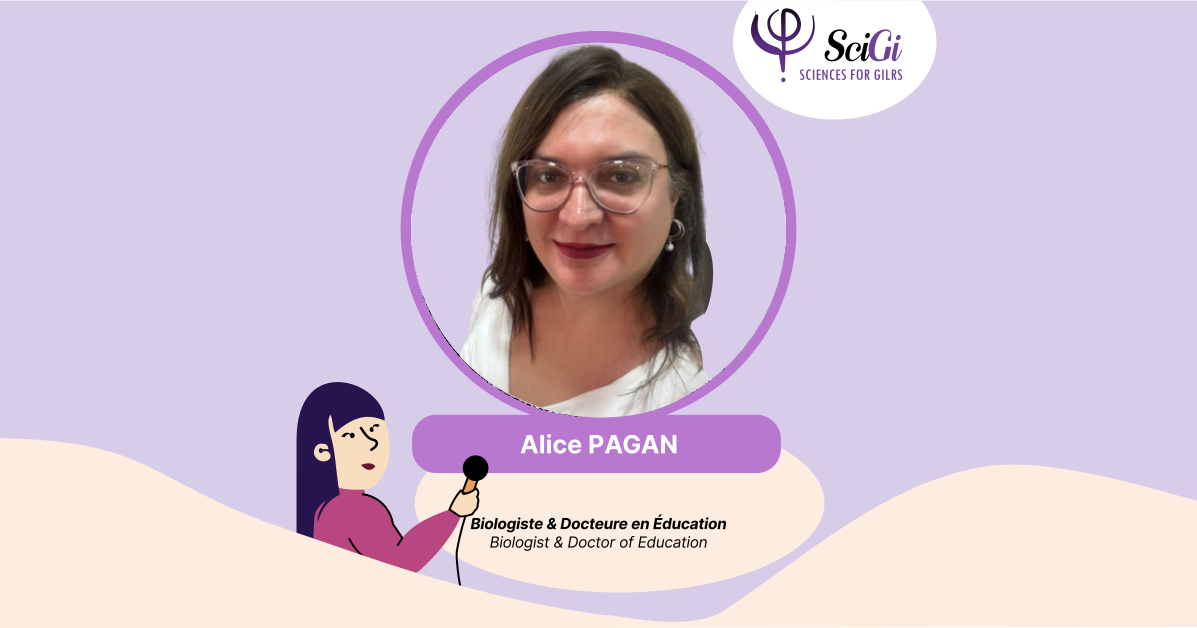
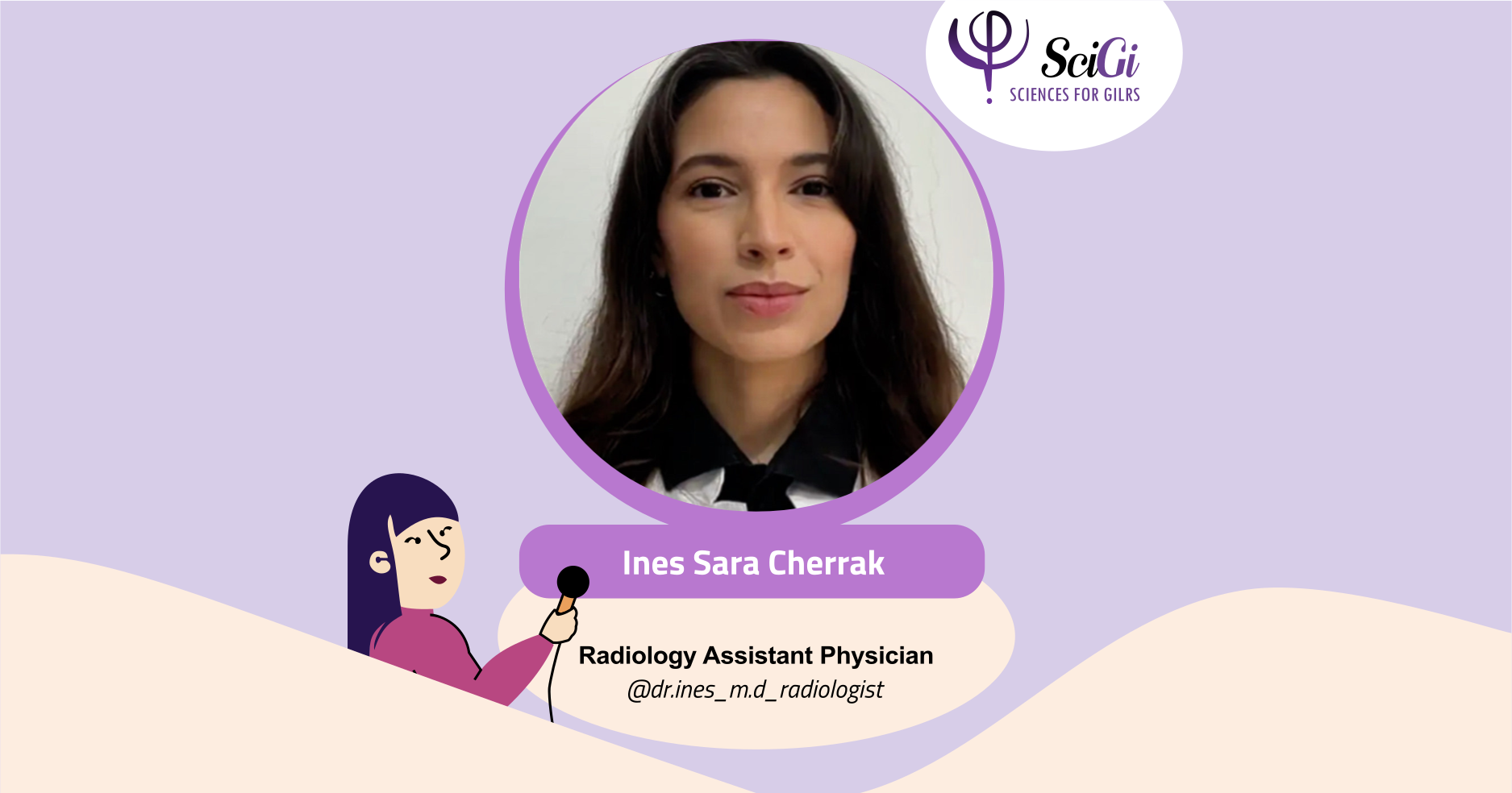
Discover the exciting journey of Alicia Rouge, an engineer and doctor in agronomy specializing in agroecology. Originally from Dijon, she now works at the Ministry of Agriculture in Paris to promote sustainable agriculture. In this captivating interview, Alicia traces her path, from her beginnings in preparatory classes to her commitment to the environment and the food of tomorrow.
I am Alicia Rouge, an engineer and doctor in Agronomy specializing in Agroecology, and currently a project officer for the Ministry of Agriculture.
I grew up in Dijon, Burgundy, where I was fortunate to complete my entire education; from kindergarten to doctorate, including the Scientific Baccalaureate, the BCPST preparatory class, the faculty of biology, and the school of agricultural engineering.
My Journey
A good student and trained equestrian, I initially oriented my academic path with the goal of becoming an equine veterinarian. After my high school years and obtaining my Scientific Baccalaureate with honors, I was accepted into the preparatory class for the top veterinary and agricultural schools, known as BCPST or agro-vet prep. This BCPST prep is the main entry route to higher schools of veterinary medicine or agronomy (agriculture and food science). My two years of prep were the two most intense years of work in my life, but I was fortunate to share them with classmates who, 10 years later, are still part of my close circle.
Unfortunately (but rather fortunately now), my two years of hard work in prep ended with a crushing failure in the A-level entrance exam for veterinary and agricultural schools, calling into question my desire to become an equine veterinarian; because at the time, I did not want to start my career at 30 (veterinary studies with specialization last at least 6 years).
The possibility of repeating my 2nd year of prep to retake the A-level exam was not feasible for me without my classmates, and not having the desire to redo a year of learning I had already completed, I reoriented myself to the faculty of biology with the option to prepare for the B-level exam, aiming to retake the entrance exam for agricultural engineering school.
It’s important to know that there are several routes to take the entrance exams for agricultural or veterinary schools: the BCPST or TB prep, which prepares for the A-level exam, the faculty which prepares for the B-level exam, and the BTS/DUT (or BUT now?) which prepares for the C-level exam, and an integrated prep path.
Fate having once again decided a different plan for me than the one I had envisioned: I encountered a reform year for the B-level exam that required me to complete two years of preparation (L2 then L3) instead of one. I then found myself at university preparing for the B-level exam over two years instead of one, with a university program that doesn’t even represent a fifth of everything learned in prep for the A-level exam. I was then able to enjoy my post-prep youth while combining a student job with my university studies to finance my young adult life. Also, some university courses were complementary to what I had learned in prep, and I was happy to learn new things.
After 2 years at university, at the top of many rankings thanks to my previous training, which allowed me to regain confidence after failing the A-level exam, I passed the B-level entrance exam for agricultural engineering school with flying colors. This offered me the possibility to choose among all the agricultural schools in France. I chose the school in Dijon for two reasons: (1) in this school I could be a civil servant of the Ministry of Agriculture, meaning I would be paid to study (and thus continue to finance my young adult life) and ensure a job at the end of my 3 years of study (by signing as a civil servant at the Dijon school, we commit to working at least 8 years for the State after the 3 years of school) and (2) I stay in Dijon close to my family and friends.
Three years of “engineering school pass” during which I learn everything about agronomy. I choose to specialize in agroecology during my training, sensitive to productivist production methods and their negative consequences on human health, the environment, and biodiversity.
Finally, after university where I definitely didn’t want to become a teacher-researcher after seeing my professors, here I am, after 3 years of “engineering school, decided to step into the world of research. My specialization in agroecology at the” engineering school in Dijon fascinated me and I wanted to specialize even more in this discipline. My 3 years of thesis were the richest in learning experiences of my life. All the conditions were met for me to excel in this stage: good supervision, a fascinating subject, a good work-life balance, and high-quality surroundings (colleagues and loved ones).
Finally, after three years of engineering training and a doctorate in agronomy, specializing in agroecology, I decided to put my knowledge at the service of the Ministry of Agriculture in a position promoting the deployment of agroecology in French farms.
What is agronomy and why did this discipline spark my interest?
Agronomy is the science in service of agriculture, and agriculture is the basis of our food. I have always been passionate about science and living things: understanding the mechanisms of life on Earth is essential to me. Knowing that our food conditions our existence on Earth, working in the field of agronomy sparked my greatest interest.
Agriculture has had a particular history, especially after World War II, when chemistry (synthetic fertilizers and pesticides) and mechanization rapidly developed. The industrialization of agriculture, based on the use of chemicals and mechanization, allowed for increased agricultural production and solved the problem of famine in many countries after the war. However, today, agricultural production based on chemicals and mechanization shows limits: living organisms adapt to farmers’ practices (resistance of certain species to pesticides), soils (the basis of agricultural production) are being depleted, biodiversity is eroded, the climate is warming and becoming uncertain, etc.
The challenge of producing differently and on a large scale is complex, especially in the globalized context in which we live. But French agriculture, the leading power at the European level, could serve as a model. Since 2009, multiple public policies in favor of environmentally friendly agriculture have been deployed in France and the European Union. Environmental certification was created in France in 2012 to encourage French farms to adopt environmentally friendly agricultural practices (for example, replanting hedges, diversifying crops, covering soils).
It was also in 2012 that the concept of agroecology became famous. Although there is no consensus definition of agroecology, the term mixes two scientific disciplines: agronomy and ecology. One could say that the objective in agroecology is to produce food without degrading the environment and biodiversity. Scientifically, agroecology relies on ecological processes that naturally exist in the environment to optimize them with regard to the objective of producing agricultural food.
From engineering school to doctorate, what do we learn?
Studies in agricultural engineering schools are often perceived as easy, at least for students who have done a BCPST preparatory class. The exam system is closer to that of university: we have lectures to learn lessons and (practical/tutorial work) to apply, then exams at the end of the semester with previous years’ papers to copy what we’ve learned and move on to the next semester if we have the average. The most interesting part of engineering school in my opinion is the internships. At the Dijon school, the first-year internship is done on a farm. You have to start with the basics; if you want to be at the service of agriculture, you need to know what agriculture is. Working on a farm is the best learning experience. Even though several times during my internship I wondered why I needed to clean this tractor to learn what agriculture is, this 6-week experience was more than instructive and I was lucky to end up with a passionate and caring family of farmers.

In the second year of engineering school, we do a 6-month internship abroad: by far the best experience of my life that launched the following ones. As a great lover of the Spanish language since middle school, I naturally chose Spain for this internship, Olé! Moreover, it wasn’t too far from my native Burgundy, so a good compromise in case of an urgent need to return home. For this internship in Spain, I chose a research lab on weeds and cover crops.

Why a research lab? Because in the first year of engineering school as a civil servant, we also do internships in the Ministry’s services. I had chosen to do two internships in Dijon, one at the DDT (Departmental Directorate of Territories) and one at the DRAAF (Regional Directorate of Agriculture, Food and Forestry). Oh yes, you should know that in your professional life later, especially if you choose to work for the public service, you will only speak in acronyms. I was fortunate to be supervised during my two internships by former students of the school and to learn more about the possibilities of professional paths after engineering school. My internship supervisor at DDT then taught me that it was possible to do a doctoral thesis in agronomy after engineering school, even as a civil servant. This first encounter led me to other meetings with alumni who had chosen this path, hence my interest in doing an internship in a research lab during my first internship abroad.
As this research internship was fascinating, I decided to conduct my final 6-month engineering studies internship in a research lab again and to propose to my future supervisors to continue this internship with a doctoral thesis. Once again, it turned out that the only INRAE (National Institute for Agricultural, Food and Environmental Research) laboratory dealing with agroecology and weeds is located in Dijon (the chance to continue my studies close to my loved ones). My application having been selected by the Ministry of Agriculture (my employer) among the list of school graduates applying for this opportunity, here I am off for 3 years of thesis at the UMR (Mixed Research Unit) Agroecology in Dijon to work on cover crops and their effects on the biological regulation of weeds in large-scale cropping systems.


Research is a very comprehensive work that allows you to acquire many skills: improving English through reading and writing international scientific articles, in-depth expertise on the thesis subject, ability to analyze, synthesize and write, teamwork, supervising interns, and for those who wish and choose a more ‘classic’ thesis path, teaching courses to students at the university.
The similarity between engineering school and a doctorate in agronomy is that at the end of your 3 years of study, you must submit a manuscript (we rather say memoir for engineering school) and present (we rather say defend for the thesis) this project orally. It is this final test that will determine whether or not you will be awarded the diploma. Let’s say that the manuscript and oral presentation in engineering school give you a small idea of what you will have to do in a thesis, at least if you choose a final engineering internship in a research lab: you will have to structure this manuscript into 6 parts (context, problem statement, materials and methods, results, discussion, conclusion). The difference is that at the end of engineering studies, you do a 6-month internship, a manuscript of about thirty pages and a 40-minute oral presentation (20 min presentation + 20 min jury questions), whereas for a thesis it’s 3 years, a manuscript of about 200 pages and a defense of about 3 hours (45 min presentation + about 2 hours of jury questions).
Link to my thesis manuscript:
Link to my thesis defense:
How does the research process unfold?
The first step in a thesis is to read multiple scientific articles and reviews on the thesis subject to understand what is already known and what remains to be elucidated. This helps to determine which research questions to address in the thesis. Once the question(s) are defined, one must figure out how to answer them, relying on the advantages, disadvantages, and complementarity of each method. After finding and applying the method, the analysis of results should put these new findings into perspective regarding current knowledge. This is how research work is valued when publishing a scientific article: there are always 4 parts, the context and problem statement, the materials and methods to address it, the results, and then a discussion on what these results contribute in relation to current knowledge on the subject.
Links to scientific articles from my thesis:
Another important form of research work promotion is popularization: scientific advances in agroecology must be popularized for practical application by actors in the agricultural world. This can be done through writing articles in journals, presenting research work at conferences or to students, or organizing field days with farmers and agricultural technicians.
What My International Experiences in Spain and the United States Brought Me
By far the best experiences of my life: going abroad alone to work in a completely unfamiliar environment is the best way to learn about oneself and gain self-confidence, in my opinion.
These experiences abroad allow one to open their mind to other ways of functioning, other languages and cultures, and to develop their adaptability skills to live in harmony with the inhabitants.
These experiences abroad also allowed me to realize the upstream organization of trips: finding a host lab, developing a research project, seeking funding, administrative formalities, etc. I was fortunate for these two experiences in Spain and the United States to travel in comfortable conditions thanks to supportive contacts and two financial scholarships: Erasmus for my trip to Spain and Fulbright for my trip to the United States.
My Work Today
After my thesis, I wanted to put my knowledge at the service of public action. And what better for me than to work on a policy in favor of deploying agroecology across the territory?
The environmental certification is a system that was created by the Ministry of Agriculture in 2012. The highest level of this certification is level 3, which we call High Environmental Value. This certification allows certified farms to display a logo on their products. This logo is mainly present on wine bottles in stores today, but it is primarily a certification for all farms that adopt environmentally friendly practices. Four themes are currently evaluated in the environmental certification: biodiversity, plant protection strategy (use of pesticides), nitrogen fertilization management, and irrigation management.
My position as an environmental certification project manager is performed as a pair. We are not too many at the Ministry of Agriculture to ensure the management of this priority government policy. Indeed, the position of environmental certification project manager is very broad because we manage the environmental certification from A to Z:
From creating a reference framework (or specifications) for the High Environmental Value certification updated with regard to scientific and technical advances in agroecology, and adapted to all agricultural sectors,
to facilitating the national commission for environmental certification,
including managing environmental certification audits in the field with certifying bodies,
creating a database to enhance environmental certification data,
and even creating a communication plan to make this certification known to as many people as possible, from farmers to French consumers.
This is a Category A position in the civil service. The engineering school in Dijon allows access to it after 3 years of studies when one has chosen the civil servant track. After 3 years of engineering studies in Dijon, we become IAE for Engineer of Agriculture and Environment. My three years of thesis allowed me to access this position level 2 (more civil servant jargon) in the central administration of the Ministry of Agriculture. It’s important to know that a Ministry is well structured: a Minister, their cabinet and the general secretariat, the general directorates (there are 3 for the Ministry of Agriculture), the regional directorates, and the departmental directorates. I work as a project officer for environmental certification at the DGPE, which stands for General Directorate for Economic and Environmental Performance of Enterprises.
It’s also worth noting that IAEs are not the only Category A staff at the Ministry of Agriculture: there are also IPEFs (Engineers of Bridges, Waters and Forests) who are even A+ and usually come from “École Polytechnique, AgroParisTech or ENS (École Normale Supérieure), ISPVs (Inspectors of Veterinary Public Health) who are generally qualified veterinarians, fifth-year students from” veterinary school, Polytechnique students or ENS students, administrative attachés, Research or Study Engineers, or even non-civil servants recruited on permanent or fixed-term contracts. This list is not exhaustive but gives you an overview of the multiple possible paths to access a managerial position at the Ministry of Agriculture.
Why is my work important for the future?
The challenge of producing food with fewer pesticides and chemical fertilizers is complex in the current economic context. However, in the context of climate change, it is necessary to reconcile agricultural production and the environment.
What I particularly like about the High Environmental Value certification is its incentive and educational nature: farmers choose whether or not to adopt certain agroecological practices, and the more they implement, the more points they gain in the certification.
Although the certification framework (or specifications) for environmental certification needs to be optimized for better adaptation to different sectors, considering technical and scientific knowledge in agroecology, and a communication plan for this certification must be implemented to accelerate its deployment on farms, I believe that all policies and actions promoting the deployment of agroecological practices on farms are levers to be activated to move towards more environmentally friendly agriculture. Ultimately, it’s like in agroecology: we will need to combine several levers (techniques or agroecological practices) to achieve agriculture that is less dependent on pesticides and synthetic fertilizers.
The activities in the position of Environmental Certification Project Officer at the Ministry of Agriculture are very varied. However, most of my time is devoted to reflection and production of analyses and summary notes to guide policy decisions around environmental certification. Working in a general directorate of the Ministry puts you closest to political decision-making. Decisions on Environmental Certification are made within a National Commission, for which the Environmental Certification project officers manage the secretariat.
A Day as an Environmental Certification Project Officer at the Ministry
A typical day would consist of responding to requests from the hierarchy and the Minister’s office as a priority, then responding to requests from certification bodies and certification operators, and then thinking about the future of environmental certification (facilitating working groups, meeting with scientific and technical experts, participating in symposiums presenting agroecology research work, visiting farms and downstream companies).

A motto I’ve heard from many colleagues I met during my internships at engineering school is that a position at the Ministry of Agriculture is what you make of it. I have a great deal of autonomy in achieving the objectives set for environmental certification, and on a daily and weekly basis, I decide my schedule according to how I work best.
My Life Outside of Work

Travel, family, friends, drawing, singing, reading, sports, hiking, ecology, piano, cooking, tourism in France and Europe, cycling… The list of my activities is long because I’m very curious, adventurous, and what I love is always discovering new things. I’m fortunate to be able to thrive outside of my work with activities that complement my professional life (especially in terms of creativity).
My Advice
My personal motto is to live as if I were to die tomorrow and learn as if I were to live forever. Words from a great humanist, Gandhi. I would also say that life is full of unexpected events, which, even if they challenge our plans, can allow us to take different but equally enriching paths. It all depends on how we choose to seize opportunities or not.
It can be difficult in high school to know where to go, particularly after general studies, but there’s no need to worry, things and our desires become clearer as we gain more experiences. Also, a career choice at one point in time doesn’t mean you’ll do that for the rest of your life; it’s never too late to evolve and change paths. A management position allows you to acquire skills useful for any other management role, even in a field different from where you started.
LinkedIn profile:https://www.linkedin.com/in/alicia-rouge-a3bb4714b/
Edited by Sylvana and Serena