Summary
Alexandra Moulin, the young director of a company that relocates energy production and president of a citizen cooperative, is gradually making her mark in the political and energy sectors. Despite the increasing number of women in these fields, legitimacy remains a challenge. Alexandra Moulin shares her thoughts and strategies for asserting her place.
Alexandra Moulin interview, Local energy transition in Millau, Women's leadership in energy, renewable energy, Sud Energia citizen cooperative, SEM Causses Energia Occitanie, Collective self-consumption of photovoltaic energy, Gender parity in technical professions, Ecological and political commitment, Strategies for professional legitimacy
Introduction
“While a new study shows that limiting global warming to +1.5°C is now unattainable, the world continues to operate on an insatiable production model. Yet, numerous scientific articles propose concrete actions to be implemented collectively and individually to avoid the most pessimistic scenarios. Among these actions: phasing out fossil fuels. Alexandra Moulin tells us about her ecological and political commitment.”
Alexandra Moulin interview, Local energy transition in Millau, Women's leadership in energy, renewable energy, Sud Energia citizen cooperative, SEM Causses Energia Occitanie, Collective self-consumption of photovoltaic energy, Gender parity in technical professions, Ecological and political commitment, Strategies for professional legitimacy
“Hello Alexandra, can you introduce yourself?”
“Hello, my name is Alexandra Moulin, I am 32 years old, and I have lived in Millau (Occitanie) for 5 years. I work as the director of a semi-public company (SEM Causses Energia) whose objective is to provide local authorities within the Grands Causses Regional Natural Park with a tool for financing and managing their energy transition. Specifically, we aim for local energy production and collective self-consumption.
In parallel, I have been president of a citizen energy cooperative (Sud Energia) with 175 members in Millau for 5 years. I founded the “Millau 2050″ movement, which is based on the Europe Ecology – The Greens political party, whose objective is to reflect on and implement public policies today to ensure the sustainability of Millau tomorrow.”
Alexandra Moulin is also involved in community projects aimed at promoting sustainable energy and raising public awareness of environmental issues.

Naturel regional Park of Grandes Causses
Source: https://www.parc-grands-causses.fr

Paysage du Parc naturel régional des Grandes Causses
Source: https://www.parc-grands-causses.fr
Alexandra Moulin interview, Local energy transition in Millau, Women's leadership in energy, renewable energy, Sud Energia citizen cooperative, SEM Causses Energia Occitanie, Collective self-consumption of photovoltaic energy, Gender parity in technical professions, Ecological and political commitment, Strategies for professional legitimacy
“What are your missions?”
“The core of my work at the SEM (Société d’Économie Mixte, or mixed-economy company) is developing the wood-fired heating network, which means promoting energy production using local wood, given the abundance of forest resources in Aveyron. My other role within this mixed-economy company is managing the business itself, particularly its financial, conceptual, and strategic direction. The goal is to engage local authorities and businesses in the vision I’m developing as director, through the purchase of shares. For example, in 2025, I led a fundraising campaign to recapitalize the SEM. I had to convince all the stakeholders involved to recapitalize the SEM, and we found investors and institutions willing to invest.
On the other hand, with Sud Energia, where I am president, the objective is to facilitate a bi-monthly cooperative council and to generate new momentum through our collective management. The main project at the moment is collective self-consumption. It allows the inhabitants of a rural community, after subscribing to the cooperative, to benefit from the energy supplied by the photovoltaic roof of the village hall (a public building).”
Alexandra Moulin works closely with local stakeholders to develop initiatives in support of the energy transition.

Sud Energia event poster
Source : https://scontent-cdg4-3.xx.fbcdn.net
Alexandra Moulin interview, Local energy transition in Millau, Women's leadership in energy, renewable energy, Sud Energia citizen cooperative, SEM Causses Energia Occitanie, Collective self-consumption of photovoltaic energy, Gender parity in technical professions, Ecological and political commitment, Strategies for professional legitimacyDonella Meadows, Systems thinking, Limits to growth, Sustainable development, Leverage points, Club of Rome, Sustainability Institute, Climate change, Social justice, Environmental education
Alexandra Moulin interview, Local energy transition in Millau, Women's leadership in energy, renewable energy, Sud Energia citizen cooperative, SEM Causses Energia Occitanie, Collective self-consumption of photovoltaic energy, Gender parity in technical professions, Ecological and political commitment, Strategies for professional legitimacy
“Why did you choose this profession?”
“I couldn’t imagine spending my life watching climate change progress without taking action. With these commitments, I feel like I’m doing my part. I’m convinced that energy brings people together, that it’s a topic that allows us to address other issues. When we talk about energy, we’re talking about individual and collective needs, energy efficiency, consumption, pollution, and so on.”
As part of her duties, Alexandra Moulin often faces challenges related to gender equality in a predominantly male sector.
Donella Meadows, Systems thinking, Limits to growth, Sustainable development, Leverage points, Club of Rome, Sustainability Institute, Climate change, Social justice, Environmental education
Was there a triggering event?”
“I don’t recall a specific event that triggered my interest in ecology. I was exposed to it from a young age: my stepmother often told me, “You’ll see, the earth will get its revenge.” In the rural school I attended, we learned to clean the banks of the Loire River and to sort batteries and other waste. Later, during my studies at Sciences Po, my awareness continued through interactions with committed organizations, conferences, and meetings.”
Alexandra Moulin has always been passionate about ecology, a passion that has guided her in her professional choices.
Alexandra Moulin interview, Local energy transition in Millau, Women's leadership in energy, renewable energy, Sud Energia citizen cooperative, SEM Causses Energia Occitanie, Collective self-consumption of photovoltaic energy, Gender parity in technical professions, Ecological and political commitment, Strategies for professional legitimacy
“Can you tell us more about your student background?”
“I have a high school diploma in Economics and Social Sciences, then I went on to study Political Science in Lyon. I spent a year in Krakow, Poland, on the Erasmus program. My background is primarily in sociology, but thanks to my early professional experiences, I’m able to transition from a sociological to a technical profile.”
As a student, Alexandra Moulin also participated in several conferences on sustainable development and renewable energy.
Alexandra Moulin interview, Local energy transition in Millau, Women's leadership in energy, renewable energy, Sud Energia citizen cooperative, SEM Causses Energia Occitanie, Collective self-consumption of photovoltaic energy, Gender parity in technical professions, Ecological and political commitment, Strategies for professional legitimacy
“In terms of gender parity, how does it work?”
“In the cooperative’s steering committee, there are 10 of us, and I’m the only woman. I don’t recall the exact figures for the SEM’s members, but women are significantly underrepresented. I’ve observed a difference between rural and urban areas, particularly in technical fields. There’s a growing number of women in technical professions, but it’s less noticeable in rural areas. I work extensively with small and medium-sized enterprises, and it’s often men who inherit family businesses. I believe women feel less entitled than men to take their place. I think there’s also a generational issue. I’m convinced that in 10 years, there will be more women because there will have been a generational shift. Older women feel more legitimate in fields like healthcare and social work, but I’m optimistic about the next generation; they’re not afraid to tackle these issues.”
Alexandra Moulin noted the importance of balanced gender representation in discussions on energy and politics.
Alexandra Moulin interview, Local energy transition in Millau, Women's leadership in energy, renewable energy, Sud Energia citizen cooperative, SEM Causses Energia Occitanie, Collective self-consumption of photovoltaic energy, Gender parity in technical professions, Ecological and political commitment, Strategies for professional legitimacy
How do you address gender challenges in your daily life?
“On the SEM side, there’s a tangible reality. The president and I, as director, manage the money. Quite simply, when you have a certain hierarchical position and you manage the money, in our company, you’re respected. Furthermore, I did a lot of research to understand and master the subjects. Currently, we’re drawing up specifications for district heating networks, and I work with highly technical people. I’ve done so much research that now I’m able to spot errors and challenge them. Initially, I delegated to engineering firms, which were mostly male, but now I’m autonomous in that area. All of this allows me to have confidence in myself.
What’s also important is to use very direct communication. I’ve noticed that men don’t use innuendo or euphemisms. When you use the same communication style as the person you’re talking to, you get listened to. It’s quite strategic.”
“On the cooperative side, my title also helps me: the group voted, and I was elected president.
As for the political aspect, in terms of social ease, it’s different. First, there’s a rule that parity must be respected. There, you’re in the realm of debate, so you encounter a lot of contradictions. As a woman, you’re much more likely to question your own statements. In politics, that’s my main weakness. You have to be quite confident to make assertions. I have less time to dedicate to politics, therefore less time to research, so I’m less self-assured. I’m quite good at bringing people together, but I struggle more with being assertive and winning a debate. I tend to assume the other person is right. I need to work more on that. However, I’m in close contact with elected officials, so I still feel capable of doing it.”
Every day, Alexandra Moulin faces challenges that require both technical skills and strong leadership abilities.
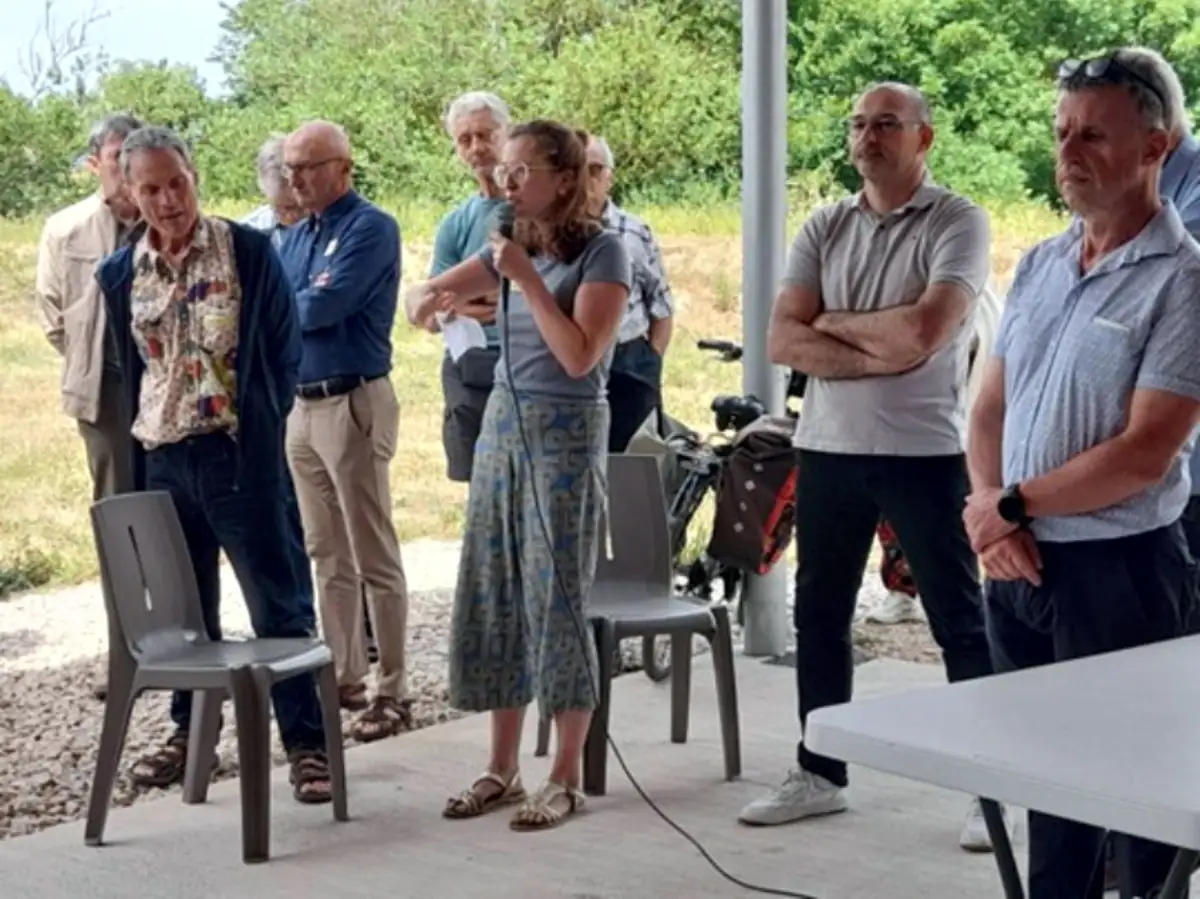
Discours devant des élus
Source : https://sciencesforgirls.com
Alexandra Moulin interview, Local energy transition in Millau, Women's leadership in energy, renewable energy, Sud Energia citizen cooperative, SEM Causses Energia Occitanie, Collective self-consumption of photovoltaic energy, Gender parity in technical professions, Ecological and political commitment, Strategies for professional legitimacy
“Do you have any final thoughts to share with our readers?”
“At 32, I believe we women possess a real strength. For one thing, if you’re alone in a group of men, you can surprise them: they don’t expect us to assert ourselves. In negotiation, for example, since they don’t expect me to be a skilled negotiator or to challenge them technically, they feel somewhat at a disadvantage. Furthermore, I think we women have a very nuanced understanding of people and situations, particularly in a social context. We understand how groups function; there’s a certain analytical ability. Because of our upbringing, we’re often more oriented towards social interaction and emotions. These are generalizations, but I think we manage very well; we find support and solidarity. We know how to ask for help, we accept our vulnerability, unlike men. We seek out skills elsewhere, and that’s our strength.”
“I firmly believe that with people like Alexandra Moulin, we can truly make a difference in our communities.”