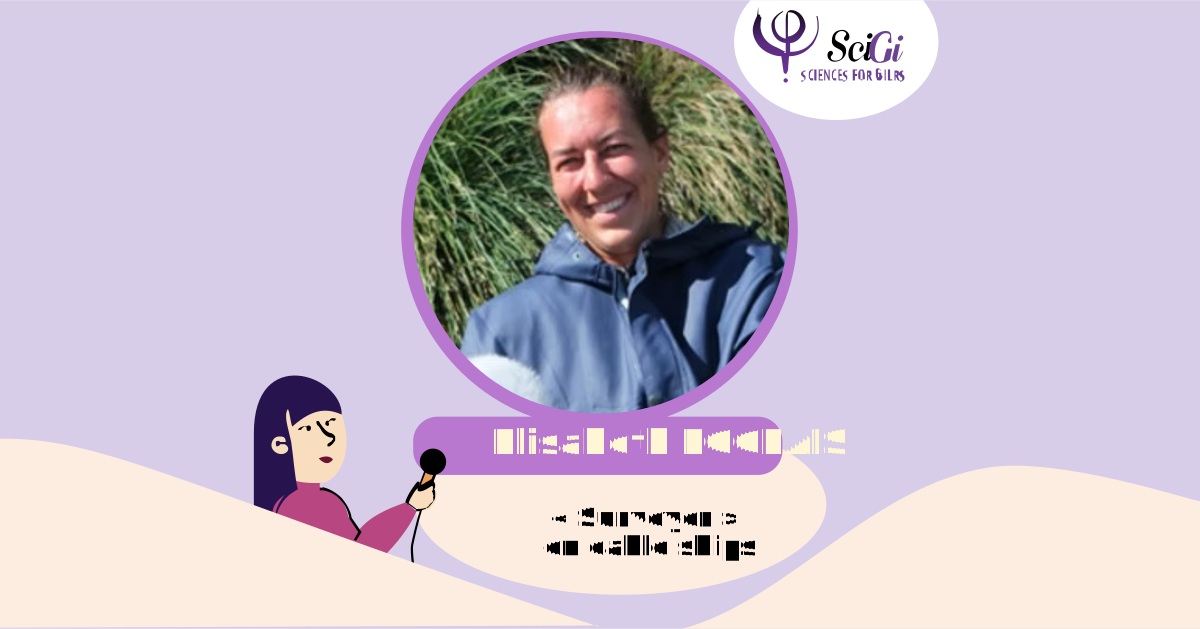

Hello to the entire SciGi family. My name is Elisabeth Logeais and I am a “Surveyor” at Louis Dreyfus Armateurs on cable ships since July 2020.


Cable ships are vessels that lay submarine telecommunication cables to connect two points across the globe. My role is to ensure the cable is positioned correctly on the seabed, following the route previously designed by engineers. This involves managing: the ship’s positioning via GPS, the acoustic positioning of various underwater devices when present, modeling the cable in the water using specific software, and ensuring effective communication with other ship teams to synchronize operations, taking into account human and material constraints.

I chose to work in the maritime field because I have always lived by the sea, in Brittany and the French overseas territories, so it’s a familiar and reassuring landscape with which I grew up. I also did a lot of sailing when I was young, and that’s when I realized I felt comfortable on the water. Moreover, it’s a complex and fascinating environment that hosts multiple forms of life, interesting physico-chemical phenomena, and still retains a sense of mystery today.

I particularly enjoy the operational aspect of my job and the interactions with all the ship’s departments to achieve our main objective (correctly laying the cable on the seabed) as efficiently as possible while ensuring everyone’s safety.
On the other hand, I appreciate the usefulness of my job in the ultra-digitalized world we live in, as I contribute to connecting countries, linking islands to continents… even though I am well aware that it remains an industry and a good portion of the data that passes through our cables is intended for multinationals or the stock market.
The offshore sector recruits a lot because it’s a sector with high turnover.
People tend to stay for a relatively short time because the somewhat “fragmented” lifestyle doesn’t suit everyone or not for a lifetime. Therefore, it’s a sector that recruits a lot since there is a constant need to replace those who leave. In my opinion, the most interesting positions are those of Operations Officer or Second Captain as they oversee all the different departments of the ship.
My journey so far? After a general Scientific baccalaureate, I did three years of preparatory classes in physics and chemistry (I repeated my second year to get into a school that suited me better). After the preparatory class, I joined ENSTA Bretagne (National School of Advanced Techniques Brittany), an engineering school in Brest. After a year of core curriculum, I chose the Hydrography and Oceanography specialization for my two years of Master’s.
The most difficult thing for me was making decisions: the decision to redo my second year of preparatory class, then the choice of engineering school, and finally the choice of specialization. It was complicated because each time I felt like I was closing doors, but in reality, I was only opening new ones by discovering new fields of activity.
Today, what am I most proud of in my journey? I haven’t mentioned it until now, but between the end of “engineering school and my current position, I went to” Amsterdam Island in the TAAF (French Southern and Antarctic Lands) where I lived and worked for a little over a year. I am very proud to have been selected to live this incredible experience.


The format of my work, based on 2 months at sea then 2 months at home, being somewhat unique, makes it difficult to have regular activities, but I am still enrolled in a rugby club. So, I do rugby training and matches when I’m on land. Otherwise, I engage in various activities on my own: hiking, gardening, reading, baking, etc.


In the maritime sector in general (including fishing, aquaculture, leisure, commerce…), the percentage of women is about 20%, but the percentage of women on long-haul voyages is less than 10%. I think it’s a field quite unknown to young girls and traditionally male, which leaves little room for women, but now we see more and more young girls in the classes of the merchant marine school, for example.
Moreover, motherhood is another reason explaining the low percentage of women on long-haul ships. Many decide not to embark (or to do shorter and more coastal voyages) when they want to start a family, while many men continue to navigate long-haul while being fathers.
If I have any advice to give you, it would be:
Follow your desires step by step without worrying about anything else. If you know why you are following a particular path, then no one can question that choice.
If this sector interests you, don’t hesitate to contact me!
Written by Emmanuelle P.
Elisabeth LOGEAIS: 2 months at sea, 2 months on land