In his book “The Descent of Man, and Selection in Relation to Sex” published in 1871, the British Charles Darwin studied human evolution and specified the theory of sexual selection. As Patricia Fara, president of the British Society for the History of Science, points out in her interview with National Geographic, Darwin’s theory of evolution argues that women are intellectually inferior to men. In an already complicated context for women, access to scientific studies for women becomes even more difficult, as their parents prefer to educate them to be good housewives, orderly and traditional.
The arrival of World War I (1914-1918) will change everything. With most men gone to the battlefield, several women seize this opportunity to mobilize and actively participate in the war effort, thus accomplishing tasks previously reserved for men. Courageous, determined, and passionate, these women have marked history. Whether unknown or famous, let’s discover the portraits of some exceptional women during World War I.
Martha WHITELEY: the Origin of Mustard Gas Used During World War I
Nicknamed “The Woman Who Made the Germans Cry”

Martha Annie Whiteley was born on November 11, 1866, in Chelsea, London (England). She is the youngest daughter of William Sedgewick Whiteley and Hannah. Not coming from a wealthy family, her studies are mostly funded by scholarships. She begins her education at the Kensington Girls’ School and in 1887 joins Royal Holloway University in London where she studies science. She obtains a degree in chemistry in 1890. In 1890, Martha Whiteley earns a Mathematics degree from Oxford University. Faced with financial difficulties, Martha Whiteley dedicates most of her career to teaching chemistry. Simultaneously, she continues her research work on the organic study of barbituric compounds and obtains a doctorate in chemistry from Imperial College London in 1902.
In 1914, the year of World War I, Martha Whiteley is forced to interrupt her research and redirect it towards work that could benefit the British army. During the war, the laboratories of Imperial College are used to analyze samples collected from battlefields. Martha Whiteley and her colleagues mainly focus on the study of irritant and tear gases that force troops to evacuate the battlefield. Martha Whiteley and her team initiate an experimental trench at Imperial College to test gases and explosives. To test the effect of gas on humans, Martha Whiteley and her team also test this gas on themselves; unfortunately, Martha Whiteley is injured during an experiment with mustard gas. Her work led to the development of explosives, one of which will be named “DW” for “Dr Whiteley”.
During this period, she also develops synthetic anesthetics.
In 1920, she receives the “Order of the British Empire (OBE) medal of honor for her scientific contributions during the war. She is a fervent activist for” gender equality in chemistry and becomes the first woman elected to the council of the Royal Society of Chemistry where she serves from 1928 to 1931. Martha Whiteley retires in 1934 and dies in 1956 from heart disease.
Louisa GARRETT ANDERSON: Pioneering Military Hospitals Led by Women

Louisa Garrett Anderson was born in 1873. She is the daughter of James Skelton and Elizabeth Garrett Anderson. Her brother and sister die of meningitis in 1875. She obtains her Doctor of Medicine (MD) in 1897 and becomes a surgeon at the Women’s Hospital.
Louisa Garrett Anderson is a pioneer of British suffragette medicine (activist for British women’s voting rights). A fervent activist, she is imprisoned for 6 months in 1912 for damaging public property to protest against an anti-suffrage speech.
With the outbreak of World War I in 1914, Louisa Garrett Anderson and her friend Flora Murray founded military hospitals in France and London. Louisa Garrett Anderson directed a Parisian military hospital that employed only women in London and Paris, where thousands of soldiers were treated. She also worked on the causes of war injuries to better prevent them.
Louisa Garrett Anderson died in 1943. In recognition of her achievements, a commemorative plaque is located in London where the military hospital was situated.
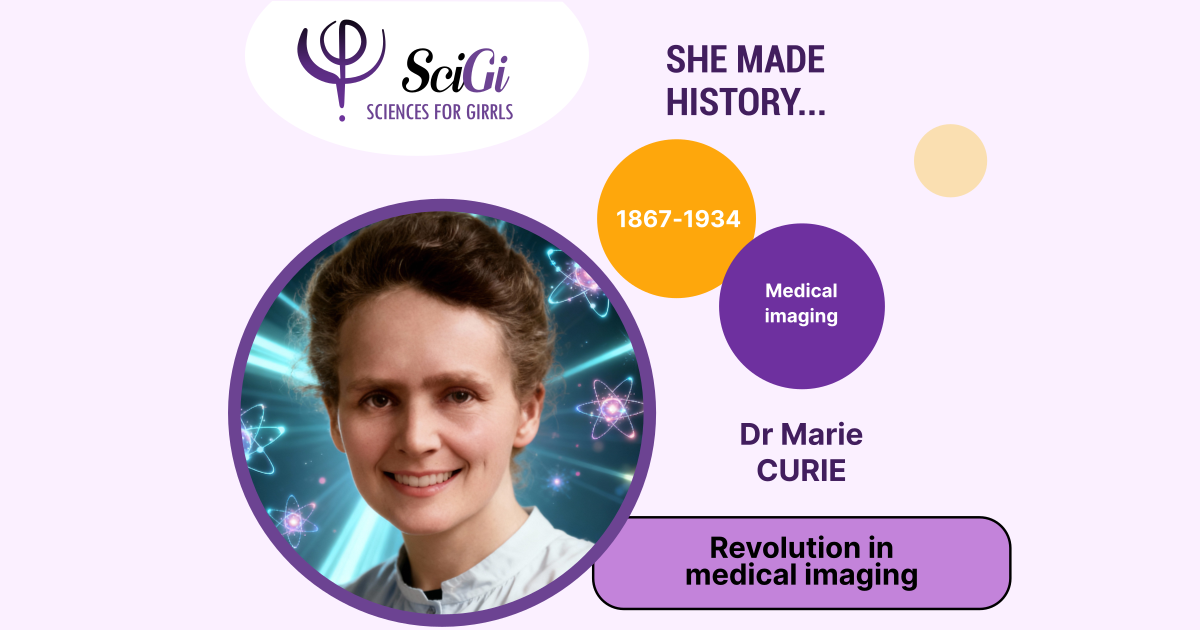
Marie CURIE: Creator of Mobile Radiological Vehicles “the Little Curies” to save Soldiers.


Helena GLEICHEN (1873-1947)

Originally a flower painter, Lady Gleichen was a wealthy aristocrat and a distant cousin of Queen Victoria. During World War I, Lady Gleichen wished to participate in the war effort. She learned to perform X-rays following the suggestion of a surgeon friend. She then offered her services to French and British offices, which refused them. She subsequently decided to go to the Italian front with her friend Nina Hollings. Aboard a mobile radiology unit, they performed X-rays on thousands of Italian soldiers who had bullets in their brains or other parts of their bodies. Lady Gleichen later obtained the rank of major in the Italian army.
Written by Monika.T and Akila.R and edited by Alizée.M
Sources:
Martha Annie Whiteley
Whiteley, Martha Annie (1866–1956), chemist | Oxford Dictionary of National Biography (oxforddnb.com).
https://www.oxforddnb.com/display/10.1093/ref:odnb/9780198614128.001.0001/odnb-9780198614128-e-46421
How World War I changed British universities forever (theconversation.com)
Comment – A temporary liberation |2014
The women we erased from history – UnHerd
How World War I Allowed Women Scientists to Prove Themselves
Louisa Garrett Anderson
Rebels, groundbreakers and trailblazers: the first ladies of surgery
Record: Papers of Louisa Garrett Anderson
Marie Curie and her X-ray vehicles’ contribution to World War I battlefield medicine (theconversation.com)
Sara Rockwell, The Life and Legacy of Marie Curie, Yale Journal of Medicine https://www.ncbi.nlm.nih.gov/pmc/articles/PMC2582731/pdf/yjbm00205-0023.pdf
Lady Helena Gleichen
Helena Gleichen: Pioneer Radiographer, Suffragist and Forgotten Hero of World War I (theconversation.com)