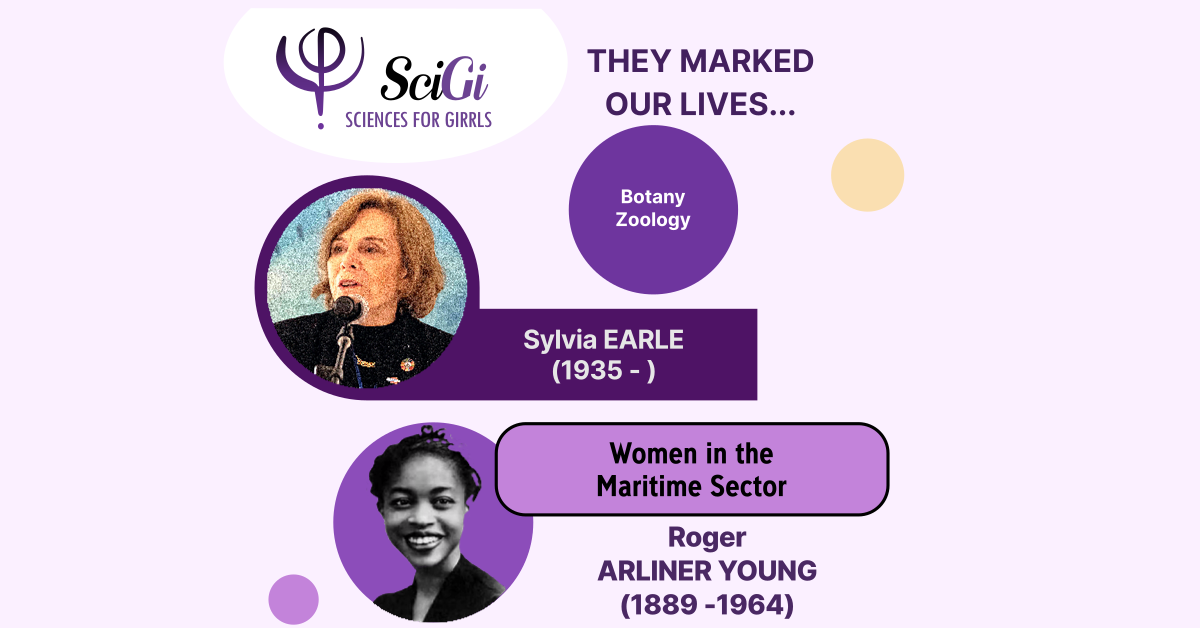
Sylvia EARLE
Feet in the Water Since Childhood

Born in 1935, Sylvia has always been passionate about the fauna and flora surrounding her. At the age of 12, when she moved to Florida, on the edge of the Gulf of Mexico, she dedicated herself to marine life.
She learned (thanks to a friend of her father) to use a diving suit. This learning experience would mark her, and it’s thanks to this new technology that she would study the seabed.

Graduating in botany in 1955, specifically in algology, she continued her studies with a doctorate at the renowned Duke University. Her thesis focused on the brown algae of her familiar gulf. However, she embarked on a major challenge: collecting 20,000 algae samples. Even today, this represents the largest recorded census.
During her research, she juggled her work as a researcher, her life as a wife, and her role as a mother. Even while pregnant, she continued her explorations.
Indeed, in 1964 she joined a 6-week expedition in the Indian Ocean. The following year she became the deputy director to Eugenie CLARK, her female role model, at the Cape Haze Marine Laboratory (Florida). It was only in 1966 that she obtained her doctorate with her thesis “Phaeophyta of the Eastern Gulf of Mexico”.
As soon as she had her diploma in hand, she continued scientific studies in collaboration with Harvard.
In the Depths

Her research led her to stay longer and longer, deeper and deeper, in the ocean.
In February 1968, she dived for the first time to a depth of 30 meters, thanks to the Deep Diver. This diver-spewing submarine allowed her to stay underwater for 1 hour and 30 minutes.
“The door to the ocean has opened” Sylvia Earle.
Passionate about this new technology, she applied for the Tektite undersea habitat program, installed in the Virgin Islands National Park, St. John, at a depth of 15 meters. Her application was rejected, as those in charge of the project did not want to mix men and women confined together.

She then decided to assemble a team composed entirely of women. This would be the second team living in the Tektite for the Tektite 2 project. Thus proving to everyone that a team of women was just as competent as men.
From July 6 to 20, 1970, the 5 women stayed in saturation in the undersea habitat. This program allowed for observing the behavior of a human group in a confined environment, evaluating the viability of creating undersea laboratories, as well as the impact on the environment.
Noting that pollution was beginning to destroy coral reefs, Sylvia would spend her life protecting and raising public awareness.
Since 1970, she has held a privileged position within the National Geographic society. In 1977, she also became a curator and researcher at the California Academy of Sciences.
She would continue her research thereafter, participating in 5 missions in the Hydrolab undersea laboratory. During another study in the Truck Islands, she collected 100 species of algae, including 15 new ones, never seen before.
Woman of Records
During her life, Sylvia made numerous discoveries, first experiences, and records.

October 19, 1979: first person to use the Jim atmospheric diving suit. With it, she explored the island of Oahu for 2 hours at a depth of 380 meters.
November 21, 1985: aboard the Deep Rover (underwater vehicle), she dived solo to a depth of 1000 m.
Led the “Sustainable Oceans” expeditions for 5 years
Founded “Mission Blue” in 2008
Author of over 200 scientific publications and 13 books
Gives lectures in more than 90 countries
Holds 27 doctorates
In total, she spent more than 7,000 hours underwater
The documentary Mission Blue is dedicated to her, if you wish to know more.
The 19th century saw many women establish themselves in the maritime field. In this domain, while Sylvia Earle fought to explore the seabed, other women, like her, fought to obtain their doctorate. Roger Arliner Young is one of them.
Roger ARLINER YOUNG
Roger ARLINER YOUNG was the first African American woman to obtain a doctorate in zoology at a time when women ‘were not made for science’. Throughout her life, she faced numerous injustices that hindered her studies. The courageous scientist fought against these obstacles to the end and proved to many that one should never give up on their ideas.
Discovery of Science

Roger ARLINER YOUNG was born in 1889 in Clifton Forge, into a poor family.
It was in Washington, at the prestigious Howard University (the most prestigious university for people of color) that she became interested in science. YOUNG went to university to study music and discovered science by chance during a zoology class. Intrigued by this teaching, she also enrolled in embryology.
Despite this interest in science, she considered becoming a social worker, a more suitable profession for a black woman. Indeed, at the time, black women who studied or worked in the scientific world were frowned upon.
However, her professors, seeing real potential in her despite her average results, encouraged her to continue in this field. One of her professors, Ernest Everett Just (director of the zoology department) even asked her to become his assistant.
“Genius of Zoology”
Following Professor Just’s request, Roger began a Master’s degree at the University of Chicago to become his assistant. In her first year, she discovered that the disparate parts of the digestive system of paramecia (aquatic unicellular organisms) come together to form a continuous digestive tube. This discovery earned her publication in the prestigious journal Science (‘On the Excretory Apparatus of Paramecium’).
She then became internationally recognized as the first published African American female researcher. Sigma Xi, an eminent scientific society, even offered her membership. Just, highlighting all these achievements, described her as a “genius of zoology”. He did not hesitate to use her talent to help him in his own studies (later we will discover that unfortunately, he never acknowledged her help, omitting to cite her in his studies).
Hindered Studies
All these research and awards further motivated Roger. She decided in 1929 to pursue her doctorate. Returning to the University of Chicago, she continued her research on the effects of ultraviolet radiation on sea urchin eggs, under the direction of Frank Rattray Lillie, a renowned embryologist and former mentor of Just.
In addition to preparing her thesis, Young was entrusted by Just with the direction of the zoology department at Howard. Remember, it was located in Washington; thousands of kilometers separated the two universities. This considerable workload prevented her from properly preparing her thesis, and she failed it.
In addition to this failure, her thesis director did not hesitate to dismiss her from his program, as the failure of his student confirmed his ideas. Indeed, the renowned embryologist defended the idea that people of color were genetically inferior to whites. He even designated the researcher as mentally deficient and sent a letter to Howard on this matter.
The shock of these numerous events pushed Roger to disappear for a while. However, the need for a salary to support her disabled mother forced her to return to Howard.
Her return was icy, even aggressive. Indeed, Just saw the researcher’s failure as a great disappointment. On one hand, she had given a bad image to his former mentor, and on the other hand, her failure put him in an embarrassing position. Wanting to create a Master’s program in zoology at his university, he did not hesitate to highlight YOUNG’s talent when seeking investors.
The biologist then wanted to get rid of her. He accused her of numerous errors, made her schedule impossible, all in order to have a reason to fire her. Which he did the following year.
Not discouraged, Roger proved to everyone that she was a true scientist by obtaining her doctorate in 1940, under the direction of Lewis Victor Heilbrunn, who this time gave her the necessary support for her work.
A Fight to the End
Following her doctorate, Dr. YOUNG worked at a small university in North Carolina.
Outraged by all the discrimination the Black population faces, she became an activist, attracting negative attention from many people, especially universities. It became difficult for her to find and keep a job. Moreover, she began to lose her eyesight as a result of her previous studies on UV rays.
Mentally exhausted, she ended up being placed in an asylum at the end of the 1950s.
Written by Maeva T.