Summary
In 1953, the discovery of the double helix of DNA changed the course of science. Behind this major breakthrough , a woman played a key role Rosalind Franklin. Thanks to her expertise in X-rays and the famous Photo 51, it enabled this revolutionary discovery, before being forgotten by History.
A look back at the exceptional destiny of a scientist whose work transformed medicine and genetics.
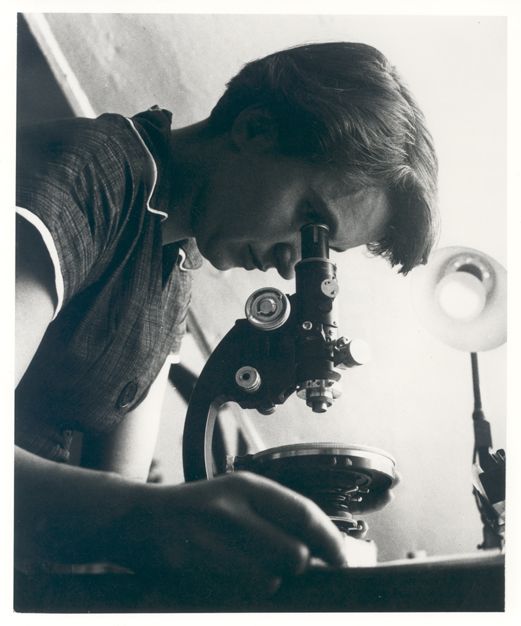
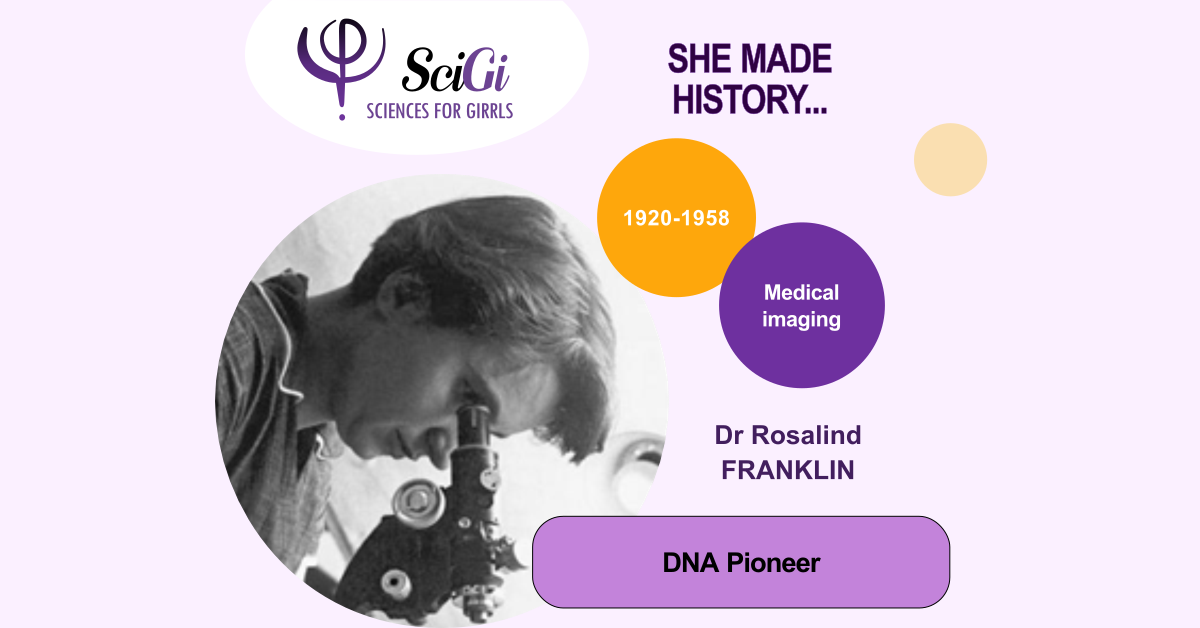
Rosalind FRANKLIN working
Source : Wikimédia.org

Rosalind FRANKLIN portrait
Source : Reddit
Understanding DNA, and in particular its double helix structure, has revolutionized our understanding of life, whether human, plant, or animal. This discovery has transformed medicine, genetics, agriculture, and biotechnology. At the heart of this major breakthrough lies the rigorous and pivotal work of Rosalind Franklin. A chemist and X-ray specialist, she played a decisive role in the discovery of the structure of DNA.
A studious youth in a world at war
Born in London in 1920, Rosalind Franklin showed remarkable intellectual abilities from a very early age. She was educated in demanding private schools before entering Newnham College, one of the few colleges for women at the University of Cambridge.
She continued her studies during the Second World War, in an extremely difficult context. While London was being bombed during the Blitz, Franklin continued to study despite air raid alerts, rationing, and constant insecurity. Her family encouraged her to leave Cambridge, but she refused. At the same time, she volunteered for air raids and closely followed international events, discussing foreign policy in her letters. Her scientific education thus took shape in the heart of a world in crisis.
In 1941, she graduated, and in 1942 accepted a position at the British Coal Utilization Research Association, which studied strategic energy resources for the Allies. There, she investigated the structure of coal and carbon, essential materials for the war effort. Her work contributed to improving their utilization.
After the war, Rosalind Franklin went to Paris to conduct research at the Central Laboratory of the State Chemical Services. There, she specialized in X-ray crystallography, a technique that reveals the structure of materials at the atomic scale. Her research on coal and graphite was groundbreaking. It led to a better understanding of the different forms of carbon and paved the way for industrial applications, particularly in the development of heat-resistant materials. At just 30 years old, Rosalind Franklin had achieved international recognition as an expert, confirmed by a vast body of scientific publications.
Then, in 1950, Franklin obtained a three-year research fellowship at King’s College London. His initial project focused on proteins, but very quickly, his mission changed. The university asked him to apply his expertise in X-rays to a still unsolved problem: the structure of DNA.
Photo 51: Seeing DNA for the first time
For several months, Rosalind Franklin worked with doctoral student Raymond Gosling to develop a device capable of producing reliable images of DNA. In May 1952, she carried out a decisive experiment: a tiny DNA fiber, as thin as a hair, was exposed for 100 hours to X-rays, under perfectly controlled conditions.
The result is spectacular. The pattern obtained on the photographic plate, known as Photo 51, clearly shows a spiral structure. Through precise calculations, Franklin understands that DNA has a helical shape, essential to explaining how genetic information is transmitted.
(Image: Extract from Rosalind Franklin’s notebook, evidence of her discovery.) The photo below shows part of her notebook where we can read (in English): “A three-chain structure implies a twist [therefore] a HELIX!” The moment when Franklin first noted her groundbreaking discovery.
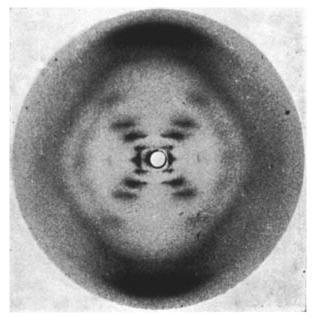
The famous Photo 51
Source : Wikimedia.org
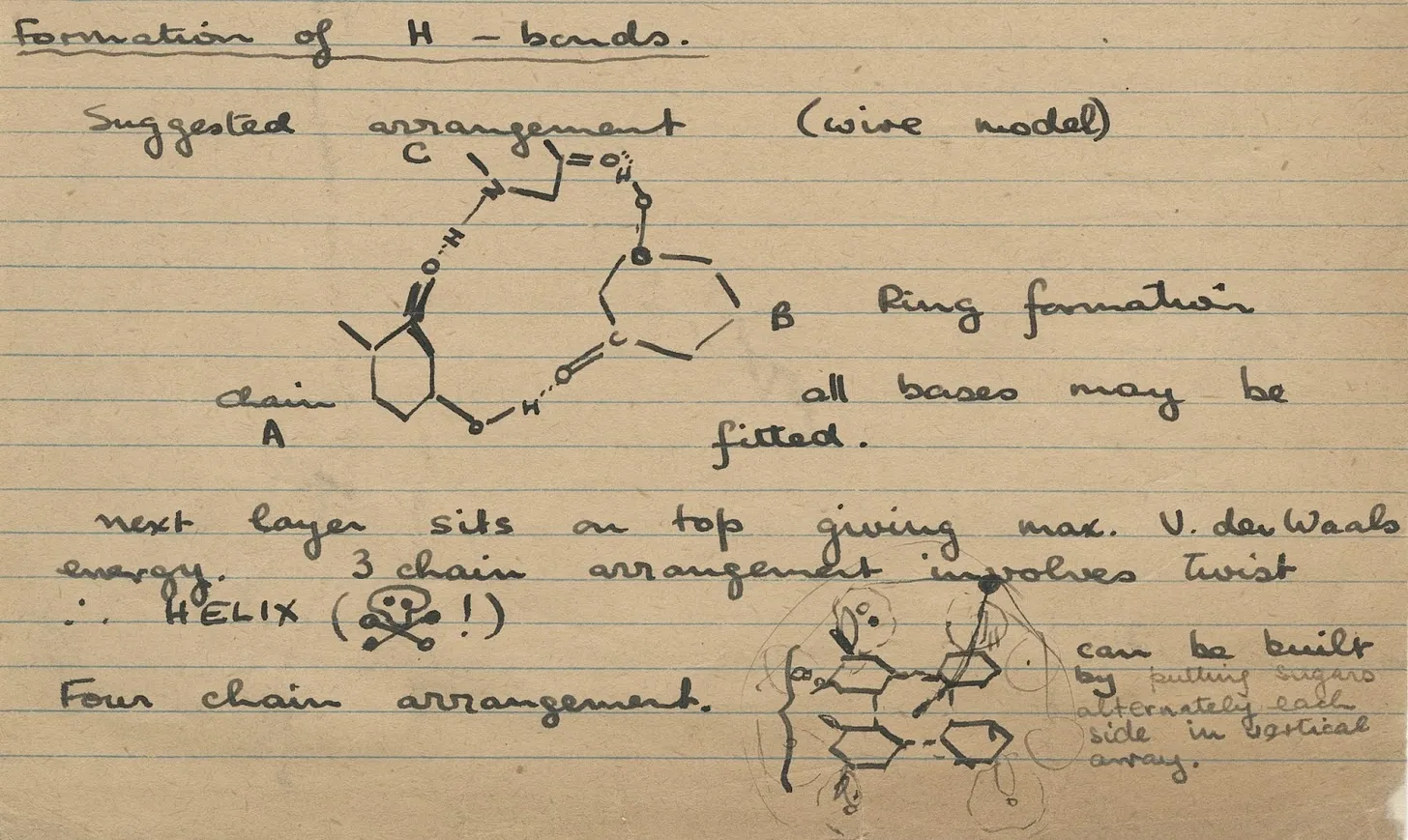
Excerpt from Rosalind Franklin’s diary, proof of her discovery
Source : substackcdn.com
The photo below shows part of his notebook where we can read (in English): “A three-chain structure implies a twist [therefore] a HELIX!” The moment when Franklin first noted his revolutionary discovery.
A long-ignored contribution
However, without his consent, some of his data, including the famous Photo 51, was passed on to James Watson and Francis Crick in Cambridge.. In 1962, Watson, Crick, and Maurice Wilkins received the Nobel Prize for the discovery of the structure of DNA. Rosalind Franklin died in 1958 at the age of 37., is not rewarded. For a long time, her role is minimized, or even erased.
In the dominant narrative, Franklin is presented as a brilliant scientist but unable to interpret her own results: she supposedly kept Photo 51 for months without grasping its importance, whereas Watson immediately understood its significance.
This account is now widely questioned. Analysis of archives, correspondence, and internal reports shows that Rosalind Franklin had already identified several fundamental characteristics of DNA, including the helical structure, the 34 Å repeat, and the external position of phosphate groups.. The 1952 report, accurately describing these elements, was communicated to Watson and Crick without his consent and played a decisive role in the final development of the double helix model.
The exclusion of her contribution can be partly explained by a sexist scientific context, in which her authority was challenged and her rigor interpreted as personal intransigence.. It was in the 1970’s, thanks to a critical re-reading of the history of science and the publication of biographical works, that its central role was gradually recognized.
Today, the study of her notebooks, publications and correspondence clearly shows that without the data produced by Rosalind Franklin, the discovery of the structure of DNA would probably not have taken place at that time, nor taken the form we know.
A brilliant career right to the end
After King’s College, Franklin went on to have a remarkable career at Birkbeck College. She is dedicated tothe study of viruses, particularly the tobacco mosaic virus and the poliomyelitis virus. His work laid the foundations of modern structural biology and contributed to a better understanding of viral infections, with significant implications for public health.
A global legacy
The impact of Rosalind Franklin’s work is immense. The discovery of the structure of DNA is at the origin of modern genetics, human genome sequencing, genetic testing, and targeted cancer therapies. In medicine, it has transformed the screening, diagnosis, and treatment of numerous diseases. Its influence also extends to agriculture, enabling the development of more resilient and sustainable crops, and to environmental research.
Rosalind Franklin not only contributed to a major discovery. She changed our understanding of life itself.
Without his work, DNA would remain a mystery to science.