Summary
Donella Meadows, a visionary scientist and pioneer of systems thinking, left her mark on the 20th century with her work on the limits to growth and sustainable development. Discover how her ideas, still relevant today, encourage us to rethink our relationship with the world and to act for a more just and planet-friendly future.

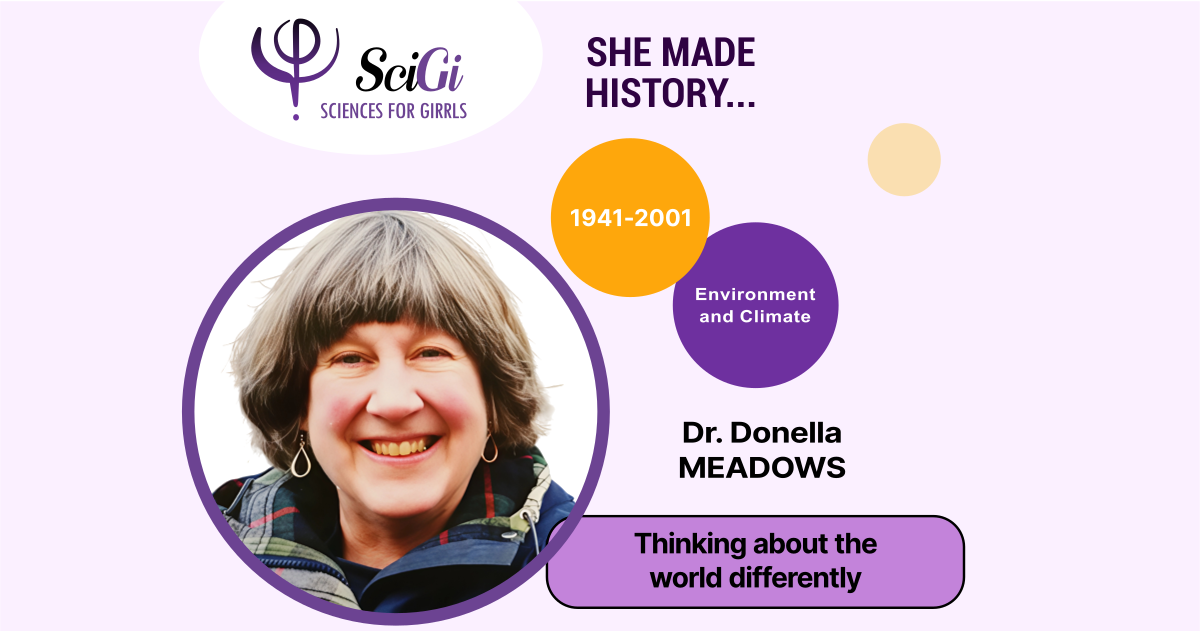
Donella MEADOWS by the river
Source : https://sciencesforgirls.com
Donella Meadows, Systems thinking, Limits to growth, Sustainable development, Leverage points, Club of Rome, Sustainability Institute, Climate change, Social justice, Environmental education
Donella Meadows: An inspiring scientist committed to the planet
Donella Hager Meadows, often called Dana, was born in 1941 in the United States. She is one of the most influential female scientists of the 20th century in the field of environment and systems thinking.
Systems thinking is a way of analyzing how all the elements of a system (such as society, the economy, and nature) interact with each other.
Donella Meadows, Pensée systémique, Limites à la croissance, Développement durable, Points de levier, Club de Rome, Sustainability Institute, Changement climatique, Justice sociale, Éducation environnementale
An extraordinary academic career and early commitment
Donella Meadows grew up in Illinois, USA. She studied chemistry at Carleton University and then earned a PhD in biophysics from Harvard. She quickly became interested in how human activities affect the planet. After her studies, she worked at the prestigious MIT (Massachusetts Institute of Technology), where she began exploring the links between science, society, and the environment.
“The Limits to Growth”: A scientific report that made history
In 1972, Donella Meadows and a team of researchers from MIT published a landmark report: The Limits to Growth. This project had been commissioned by the Club of Rome, an international group of scientists and economists concerned about the consequences of global growth. Using a computer model called World3, the team simulated changes in population, industrial production, pollution, and natural resource use. Their conclusion was clear: if current trends in economic and demographic growth continued unchanged, the planet would reach its ecological limits during the 21st century. Meadows and her colleagues did not advocate halting progress, but rather a shift toward sustainable development, a concept still relatively unknown at the time.
The book had a global impact. Translated into dozens of languages, it sparked both admiration and controversy. Many praised the courage of a young researcher who dared to question the dominant economic model. For Donella, this work was not a pessimistic prediction, but a call to collectively reflect on our future.
Systems thinking: “Understanding in order to act”
After publishing “The Limits to Growth,” Donella continued to explore what makes a system (whether a society, an ecosystem, or an economy) stable or vulnerable. She believed that creating a fairer and more sustainable world required first understanding the invisible relationships between the different parts of a system. In her famous essay, “Leverages for Action in a System,” published in 1999, she proposed an idea that has become essential: in every system, there are “leverages”—places where a small action can produce a big change. She explained that while changing certain numbers or rules might have a limited effect, transforming the goals of a system, or better yet, the beliefs and values upon which it is founded, can change the entire direction of a society.
This approach, both intellectual and profoundly human, showed that the true levers of change are not found solely in public policies, but in our way of thinking about the world. Meadows thus invited policymakers, researchers, and citizens to “see the whole,” to think in terms of relationships rather than isolated objects.

Leverage points for effective change
Source: https://www.ux-republic.com/

Leverage Points
Source : https://img.paragraph.com
Donella Meadows, Pensée systémique, Limites à la croissance, Développement durable, Points de levier, Club de Rome, Sustainability Institute, Changement climatique, Justice sociale, Éducation environnementale
Teaching, writing, and legacy
Beyond her research, Donella Meadows devoted a large part of her life to teaching. For nearly thirty years, she trained generations of students at Dartmouth University. Her lectures were renowned for their clarity and warmth: she did not simply impart knowledge, she encouraged her students to think critically and to connect science to everyday life.
In parallel, she developed a career as a writer and communicator. Her weekly column, The Global Citizen, appeared in numerous newspapers and translated global issues into simple, accessible language. She addressed topics as varied as climate change, social justice, international cooperation, and the role of compassion in political decision-making.
In 1996, she founded the Sustainability Institute (now the Donella Meadows Institute), a center dedicated to research and the promotion of sustainable living. This institution has become a meeting place for scientists, policymakers, and citizens, true to her vision of a world based on collaboration and mutual understanding.
His work has been recognized by numerous awards, including the prestigious MacArthur Fellowship in 1994, awarded to the most creative thinkers whose ideas transform society.

Portrait de Donella MEADOWS
Source : https://www.elsaltodiario.com
Donella Meadows, Pensée systémique, Limites à la croissance, Développement durable, Points de levier, Club de Rome, Sustainability Institute, Changement climatique, Justice sociale, Éducation environnementale
An extraordinary scientist
Trained in chemistry and biophysics, she mastered the most demanding fundamentals of science while maintaining a curious and open-minded perspective on the world. But Donella was not content with simply observing. For her, science, politics, economics, and ethics formed an inseparable whole, a vast system that had to be understood in its entirety.
She also possessed the rare gift of making science vibrant and accessible to all, without ever oversimplifying it. Through her writings, lectures, and teaching, she fostered curiosity and a sense of responsibility. In a scientific world still largely dominated by men, she distinguished herself through her intelligence, clarity, and kindness, paving the way for many women after her. More than a researcher, Donella Meadows was a committed voice, driven by the conviction that science should above all serve life.