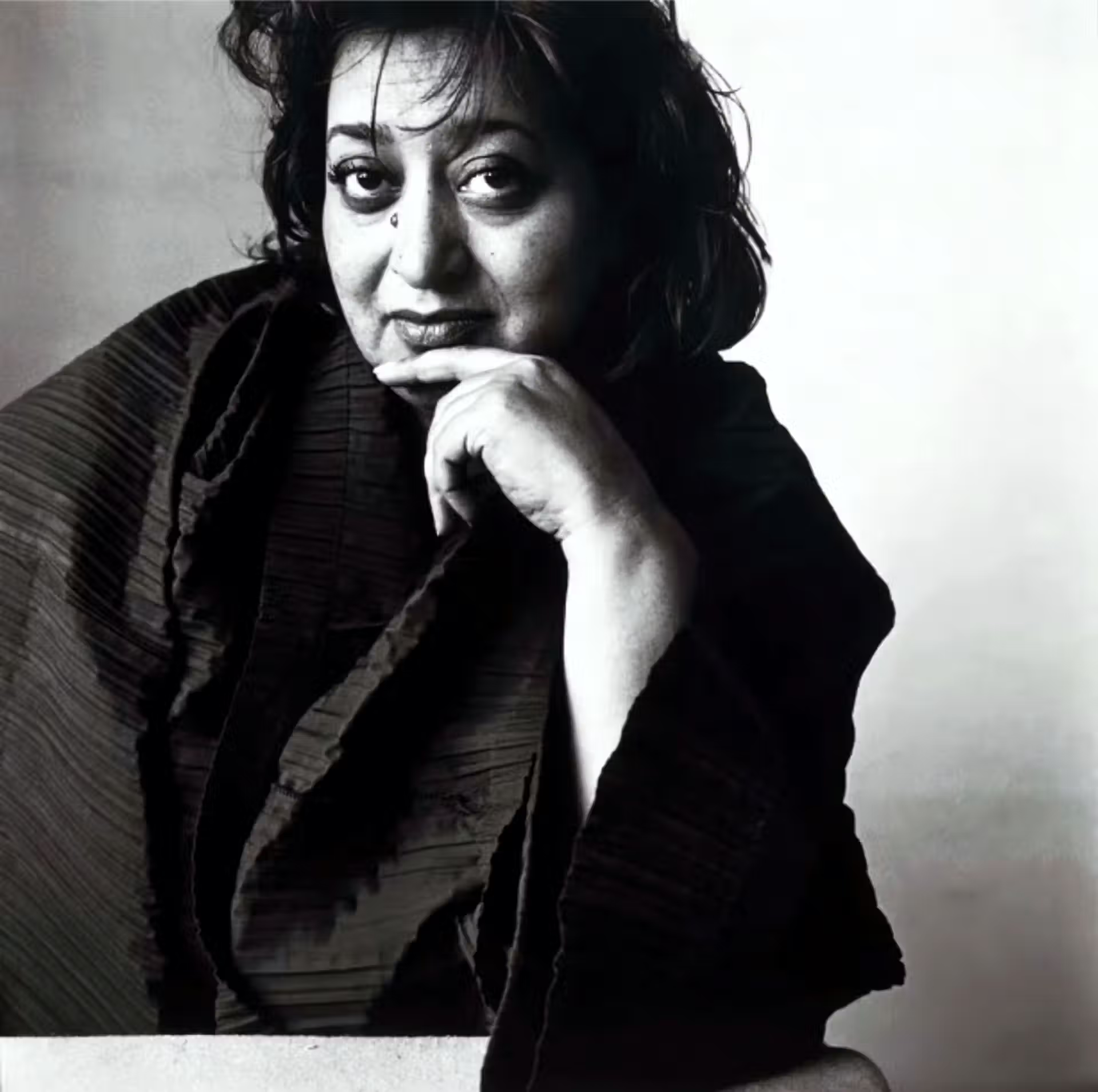
A Childhood Nourished by Art and Education

Born in 1950 in Baghdad, Zaha HADID grew up in an environment that stimulated both her creativity and intellectual curiosity. She was raised in a house inspired by the Bauhaus style, a notable example of architectural modernism that shaped her early perception of space and structure.
Her father, Muhammed HADID, an influential politician and successful entrepreneur in the textile industry, co-founded the Al-Ahli socialist movement before becoming Minister of Finance after the 1958 coup. Her mother, Wajiha Al-Sabunji, was an accomplished artist, bringing an aesthetic sensibility to the family home. These influences, blending politics, culture, and art, profoundly shaped Zaha’s aspirations.

From a very young age, she showed a keen interest in Islamic mosaics, the undulating landscapes of Mesopotamia, and complex architectural structures, inspirations that would nourish her future style.
Mathematics, according to her, was not just an academic discipline: it was a way of expressing the movements, shapes, and structures of the world around her. She often said: “Mathematics, for me, was like drawing.”
This need to translate the world through equations naturally led her to architecture, a playground where mathematical concepts transform into physical forms.
Studies Marked by a Unique Vision
 After studying mathematics at the American University of Beirut, where she explored the connections between numbers and the beauty of natural forms, Zaha HADID moved to London to pursue architectural studies at the prestigious Architectural Association School of Architecture.
There, she didn’t follow established rules, but redefined the limits of what an architect could create. During her years of study, she established herself as a brilliant and radical young woman, far from the conventions of the time.
Elia Zeghelis, a professor at the Architectural Association, considered her one of the best students he had taught during his career, and nicknamed her “the inventor of the 89 degrees.”

She was particularly influenced by thinkers like Rem Koolhaas and Bernard Tschumi, yet despite these inspirations, she maintained her unique and singular vision: she didn’t dream of aligning straight and square buildings. She saw in each space an infinite possibility, a curve that could be born, twist, or unfold.
Her early academic projects were not traditional buildings, but ideas that broke free from classical geometric constraints. In her drawings, curves seemed to live, to move, defying any static and rigid form. But at the time, her creations were often rejected, deemed too avant-garde. This didn’t discourage her: on the contrary, it strengthened her determination to go ever further.
Perseverance: from “Paper Architect” to “Queen of Curves”
For many years, Zaha HADID was nicknamed “the paper architect,” a title that reflected both admiration for her creative genius and skepticism about the feasibility of her projects. Her designs, often spectacular, pushed the boundaries of what was possible. However, this boldness was not without consequence: many of her concepts remain, even today, unfinished sketches.

 We think, for example, of the project she had imagined for the Kurfürstendamm in Berlin in 1986, or her visionary Peak Leisure Club in Hong Kong in 1983, which, despite the enthusiasm they generated, remained at the stage of simple models.
Yet, if these years of rejection would have discouraged many, Dame Zaha saw it as an opportunity to perfect herself and refine her approach. She refused to let critics define her future. And, armed with iron patience, she set out to study emerging technologies, such as parametric design, to demonstrate that what seemed unfeasible could, with the right tools, become reality.
In 1993, at 43 years old, her patience finally paid off: she completed the Vitra Fire Station project in Germany, her very first built building. This avant-garde building embodies Zaha’s deconstructivist style, symbolizing her desire to shake up conventions and redefine our vision of architecture.

The success of this project allowed her to take a significant step forward, proving that her architecture, previously confined to paper, could be translated into tangible and functional structures.
A Career Marked by Spectacular Achievements and Scientific Innovation

In 1982, she won the Gold Medal “Architectural Design” for her innovative concept of renovating a townhouse in Eaton Place, London. This project, although remaining at the planning stage, was based on meticulous calculations that allowed for rethinking space and volume organization while respecting the harmony of forms.

This scientific approach to space and geometric forms remained at the heart of her work throughout her career.

In 1988, the “exhibition ‘Deconstructivist Architecture’ at the Museum of” Modern Art in New York marked a turning point in her career. This event highlighted Zaha HADID’s innovative approach, whose projects relied on complex algorithms and geometric calculations to design structures that defied architectural conventions.
Unlike other architects attached to classical geometry, Zaha HADID used advanced digital tools, particularly parametric models, to design structures that abandoned angles and straight lines in favor of fluid, dynamic, and organic curves.

Her architectural approach relies on mastery of digital tools, such as computer-aided design (CAD) software, to push the boundaries of what is achievable.
It is thanks to her mastery of technology that she manages to realize her most ambitious projects, such as the Aliyev Centre in Baku, Azerbaijan, where the fluid curves could not have come to life without advanced digital modeling.
Parametric mathematics are at the core of her process, offering her the freedom to manipulate shapes and volumes precisely. Each project is an exploration of new possibilities, transforming abstract ideas into concrete realizations that reinvent architectural norms.
The Science Behind Architecture
Behind each improbable curve of Dame Zaha lie highly precise mathematical and scientific principles. But how do these abstract concepts take shape in “architecture? Through two striking examples, let’s dive into the” alliance between science and creation. From the meticulous calculation that structures the “London Aquatic Centre to the biomimetic inspiration of human bones in the Vitra Fire Station, each building testifies to the” incredible power of science to transform “space and push the boundaries of” architecture.
Mathematics: a Tool to Reinvent Architecture
Zaha HADID’s work demonstrates how mathematics and science can be catalysts for creativity. Rather than simply following rigid rules, she reinvents them to imagine impossible geometric shapes. By leveraging advanced digital tools, she uses algebraic calculations and dynamic systems to create buildings that seem to defy gravity.
A striking example of Zaha HADID’s scientific approach is the London Aquatics Centre, designed for the 2012 Olympic Games. Inspired by the movement of waves, its undulating roof rests on a hyperboloid surface. This elegant and functional structure, supported by only three points, is the result of advanced parametric simulations, optimizing both the distribution of forces and the lightness of the construction.


For example, the distribution of compression and tension forces in the structure was optimized by solving linear systems and integrating bending moments. The overall shape, described by a function such as z(xy) = a sin(bx) + c cos(dy), was adjusted to ensure stability and beauty.
The London Aquatics Centre proves that architectural beauty can emerge from mathematical rigor. Zaha HADID transformed abstract calculations into a tangible masterpiece, where each curve is both functional and poetic.
The Biomimicry: When Nature Inspires Architecture


The Vitra Fire Station.

When a fire truck rushes out or heavy equipment is moved, the building never experiences excessive stress at any specific point. Instead, its inclined surfaces intelligently redirect forces, ensuring exceptional stability while optimizing the use of materials. Thanks to this nature-inspired engineering, the station combines strength, elegance, and durability, proving that every angle, every line, contributes to remarkable efficiency.
Worldwide Recognition and Prestigious Distinctions
Zaha HADID’s scientific and creative genius was quickly recognized on an “international scale. In 2004, she became the first woman to receive the Pritzker Prize, considered the highest honor and” equivalent of the Nobel Prize in the world of architecture.

This recognition not only highlights her revolutionary approach but also the scientific depth that underlies her work. Her parametric algorithms and use of advanced modeling software are now considered essential tools in the world of modern architecture.


Building a Future Where Education and Creativity Transcend Limits
Zaha HADID saw architecture as a universal language, capable of telling stories, awakening minds, and above all, pushing the boundaries of what’s possible. But her ambition was not limited to her creations of glass and steel. She had another dream: to inspire young girls with a passion for science and mathematics, fields where they are often underrepresented.
For Zaha, mathematics was a form of poetry. Entering the Mathematics: The Winton Gallery at the Science Museum in London, this vision comes to life.

At the center, a 1929 airplane floats, as if carried by a whirlwind of luminous curves. These elegant forms are not just art: they embody the equations of aerodynamics, those invisible flows that make flight possible. Here, mathematics becomes tangible, almost magical.
Zaha wanted to show that sciences are not cold or abstract, but vibrant and profound, capable of telling stories about nature and human progress. “Mathematics is the fabric of the world,” she said, “and its beauty is revealed when it comes to life.”
Zaha HADID “wasn’t just a visionary architect, she was also a passionate educator. At 30, she became an assistant professor at the Architectural Association School, a position she secured thanks to her futuristic paintings. She knew that education could transform not only skills, but also lives. She admired her female students, often among the most talented, but who too often doubted themselves. For her, learning science should be a creative adventure, an invitation to explore and imagine new worlds.”

An Unforgettable Legacy
On March 31, 2016, Dame Zaha left us at the age of 66. But her legacy goes far beyond the walls she built or the theories she taught. She redefined mathematics, not as knowledge reserved for an elite, but as a universal tool, accessible to those who dare to seek, dream, and invent.
A pioneer and committed figure, she particularly influenced a generation of women architects, encouraging them to overcome barriers imposed by society. For them, her message was clear: ” You already have wings. Take flight, because you can go much further than you imagine “.
Written by Nawel and edited by Intan
Sources:
The Architecture of Zaha HADID (by Zaha HADID and Aaron Betsky)
https://atelieroz.com/portrait-dune-architecte-dexception-zaha-hadid
https://neufert-cdn.archdaily.net/uploads/product_file/file/9674/KEIM_ZahaHadid.pdf
https://www.zaha-hadid.com/architecture/vitra-fire-station-2/
https://www.archdaily.com/785760/ad-classics-vitra-fire-station-zaha-hadid-weil-am-rhein-germany
https://a3511.wordpress.com/2018/11/14/biomimicry-building-skeleton/
https://www.admagazine.fr/adinspiration/article/zaha-hadid-art-du-mouvement
https://jhprintdesign.wordpress.com/2012/04/12/vitra-fire-station/
https://edition.cnn.com/style/article/zaha-hadid-stem-month/index.html
https://fr.scribd.com/presentation/606351762/Centre-Aquatique-de-Londre
https://fr.slideshare.net/slideshow/london-aquatic-center-case-study
https://www.zaha-hadid.com/architecture/london-aquatics-centre
https://www.zaha-hadid.com/architecture/the-peak-leisure-club