Summary
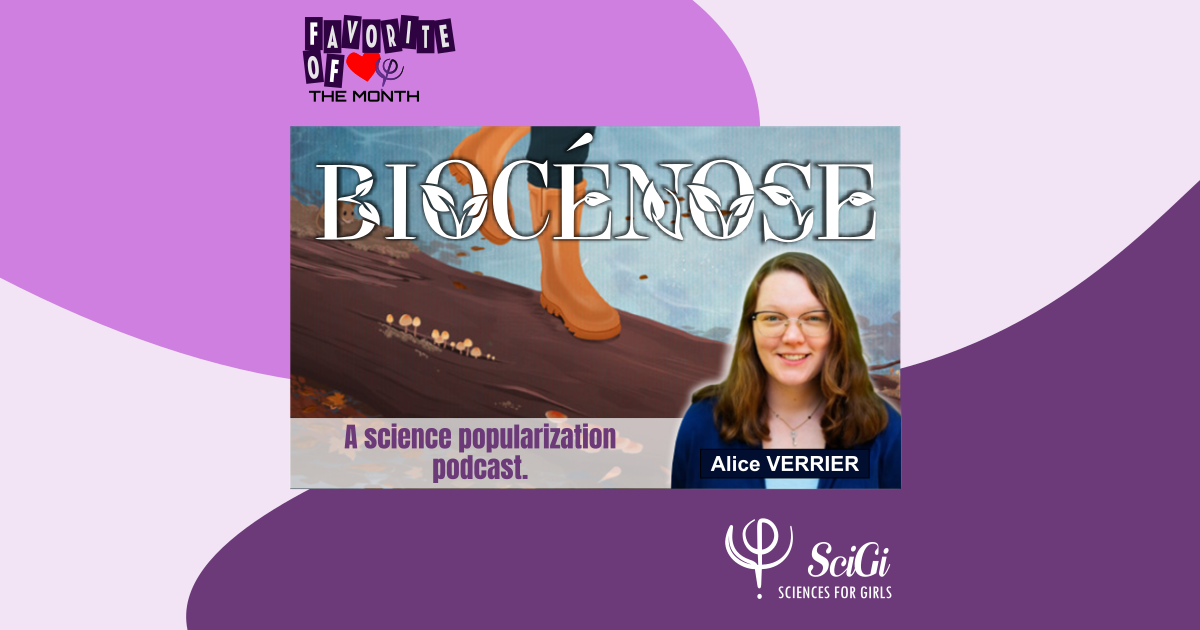
Dive into the heart of scientific research with “Biocenosis”, the science podcast that makes behavioral ecology and pollinator protection accessible to all.
In just 10 minutes per episode, award-winning teacher-researcher Elise Verrier shares her passion for living things and invites us to discover the wonders of biodiversity.
A dynamic, clear and inspiring format to understand the challenges of research and take action for the planet.
Fascinated by living things, Elise Verrier is a teacher-researcher in agronomy and behavioral ecology (the study of the behaviors that an animal adopts to maximize its chances of survival and reproduction in a given environment) at UniLaSalle.
At just 32 years old, this passionate woman has already won several scientific competitions and is eager to share her passion for research with as many people as possible. Her tool? The science podcast “Biocenosis,” an invitation to discover the wonders of ecology and the protection of pollinators, in just 10 minutes per episode.
science podcast ecology
Inspirations and rewards: the journey of a committed researcher
From middle school onward, Elise was passionate about life and earth sciences. She went on to become a doctoral student in biology at the University of Paris-Saclay, defending her thesis on pollinator foraging behavior in 2021. After receiving several awards, she is now developing a project that aims to harness the power of behavioral ecology to mitigate pollinator decline and work toward the sustainability of our agricultural systems.
Throughout her career, Elise has had many female role models. Mentored by two researchers during her gap year in England, she was also influenced by Rachelle Carson, an American marine biologist and environmental activist who, in 1962, denounced the risks of pesticides.
His diverse experiences will give him the impetus to share the advances of the world of ecological research in the form of podcasts.
Some key dates:
- 2021: Defense of his thesis in theoretical ecology on the foraging behavior of pollinators (mainly bumblebees)
- 2022: Launch of “Journal de tata doc,” her first podcast in which she interviews young researchers.
- 2022: Integration into the “BeeConnected” project (which focuses on honeybee mortality in winter).
- 2023: The “Diary of Auntie Doc” wins the “Storytelling and encountering science” prize, a competition that rewards the best popular science content published by doctoral students and young researchers from member universities of AUF Western Europe (Agence Universitaire de Francophonie).
- 2023: Awarded the L’Oréal-UNESCO For Women in Science Young Talent France Prize.
- 2024: Took up her position as a teacher-researcher in agronomy at UniLaSalle.
- 2025: The “Diary of Auntie Doc’” becomes “Biocenosis”.
The L’Oréal-UNESCO For Women in Science Young Talents Award was created in 2007.
This program is committed to supporting the involvement of young women in scientific research. It identifies and rewards outstanding young female researchers in the life and environmental sciences, materials science, mathematics, computer science and information science, and engineering and technology.
What a beautiful mise en abyme of our SciGi association, isn’t it?
/regions/2023/10/10/illustr-couv-article-1800x1200-api-65253cf9d8979717482865.jpg)
Alice VERRIER and her beehives
Source : France 3 Regions
Inspirations and rewards: the journey of a committed researcher
From middle school onward, Elise was passionate about life and earth sciences. She went on to become a doctoral student in biology at the University of Paris-Saclay, defending her thesis on pollinator foraging behavior in 2021. After receiving several awards, she is now developing a project that aims to harness the power of behavioral ecology to mitigate pollinator decline and work toward the sustainability of our agricultural systems.
Throughout her career, Elise has had many female role models. Mentored by two researchers during her gap year in England, she was also influenced by Rachelle Carson, an American marine biologist and environmental activist who, in 1962, denounced the risks of pesticides.
His diverse experiences will give him the impetus to share the advances of the world of ecological research in the form of podcasts.
Key dates in his commitment
In 2022, Elise launched her first podcast, “The Diary of Auntie Doc”, where she interviews young researchers. That same year, she joined the “BeeConnected” project, dedicated to studying honeybee mortality in winter.
In 2023, his podcast won the “Storytelling and encountering science” prize, a competition that rewards the best science popularization content published by doctoral students and young researchers from member universities of AUF Western Europe (University Agency of Francophonie).
In addition, she received the L’Oréal-UNESCO For Women in Science Young Talent Award in France. In 2024, she became a lecturer-researcher at UniLaSalle, and in 2025, “The Diary of Auntie Doc” evolved into “Biocenosis”.
What a beautiful mise en abyme of our SciGi association, isn’t it?
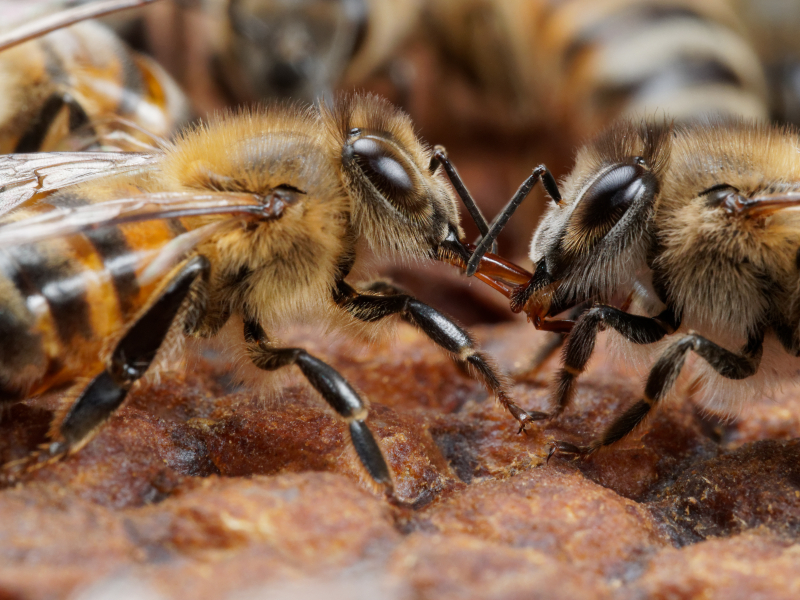
Polinisators
Source : CNRS
Why so much interest in pollinators?
Committed to climate and environmental issues, Elise wanted to understand the reasons for the decline of bees in winter in order to fight against this issue that concerns us all.
By working in collaboration with beekeepers, she was able to assess the movements of insects in the hive, analyze their interactions and observe how they consume their resources…
Generally, in winter, bees cluster together to regulate their body temperature. The average temperature around the cluster is 11 degrees Celsius, while inside the cluster it’s around 20 degrees Celsius, even if temperatures are below freezing outside the hive. The risk for beekeepers in winter is letting in cold air by opening the hives, disrupting this thermoregulation and causing the bees to die. They only reopen them in the spring and then observe high mortality rates. In recent decades, mortality has reached 25 to 50%, which is much higher than a century ago.
The “Beeconnected” program, which Elise joined in 2022, allows for the analysis of the inside of beehives without opening them, thanks to sensors, and for working on early warning indicators of honeybee colony collapse.
In an interview, the researcher points out that 35% of the world’s food production volume depends on pollination.
science podcast ecology
“Biocenosis”: a science podcast for everyone
The term “BIOCENOSIS” refers to all living organisms that inhabit a given ecosystem. It consists of three fundamental ecological groups of organisms: producers (plants), consumers (animals), and decomposers (bacteria, fungi, etc.).
Through this science podcast, Elise addresses a variety of topics, such as the intelligence of bumblebees, invasive exotic species, and the near disappearance of hedgehogs.
Elise’s aims behind this podcast are: to make research more accessible, to be the link between listeners and scientific ecology, to create a space for young researchers to speak, and to counter our eco-anxiety.
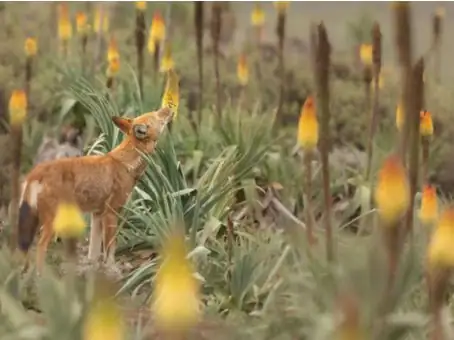
A wolf nibbling nectar from a flower?
Source : Sciences & Avenir
A noteworthy episode: “Unexpected pollinators: Is the Ethiopian wolf foraging on our flowers?”
In this episode, we learn that this pack-living canid is endangered. It’s a rodent hunter but also acts as a pollinator. A group of six wolves was tracked for four days. They were also observed tasting the nectar of Kniphofia foliosa flowers.
To officially belong to the pollinator group, there are 4 criteria to meet:
● Visit the flowers regularly without causing damage
● Transport pollen
● Depositing pollen on other flowers (this point is difficult to assess for wolves)
● Induce the production of seeds or fruit
Further studies would be essential to confirm the role of the Ethiopian wolf as a pollen vector and to change our understanding.
We also learn that there are 1500 species of pollinating vertebrates, including birds, mammals, primates, and marsupials.
Elise then raises the question of underwater pollination. Analyses carried out in the laboratory show that tiny crustaceans visit the turtle grass of a Mexican reef and spread its pollen.
What’s appealing about “Biocenosis”
- The duration: 10-minute episodes to address complex topics in a clear and concise manner.
- Dynamism: a lively and engaging tone that captures attention from the very first seconds.
- Clarity: explanations that are accessible, even for children or novices.
- The diverse themes: a rich exploration of ecology and biodiversity.
- Additional resources: links to explore each topic in more depth.
- An introduction to the profession of researcher: an immersion in the daily life of scientific research.
At the end of each episode, Elise invites her listeners to a contemplative pause, to observe and appreciate the living world around us. It’s an invitation to reflect on this quote from anthropologist Valelia Muni Toke: “We can only protect well what we know well.”
To go further
- Photo: A wolf nibbling on flowers, an unusual discovery
- Photo: Discovery of a new social learning mechanism in bees
- Podcast cover: Yrielle Foucher (@_Passye on Instagram)